Reflecting on the Essay By Conhar Scott contained in a chapter within Photographers and Research.
Brief abstract:
Within the context of discussing research and how it aids photographers, Scott defines himself “as a photographer interested in documenting Industrial Pollution. He describes how he progressively developed a method of working in order to situate his photographs within a cultural context where the photographs contribute to an advocacy process which eventually enabled him to be instrumental in instigating environmental remediation alongside the environmental science community and activist.
Reflection
I can associate my current attempts in my project with Schott’s first attempt. He illustrates that while his intentions was good, “he did not photograph the mine with an clearly defined ethical stance towards the subject matter” and “conducted no protest”, ” appealed to no-one” and only had ” a flawed objectivity” without a “coherent understanding” (Simmons and Read, 2016 pp 230-234 )
He then described how he had partially gained success as an individual collaborating with a activist organisation but finally discovered his method when he fully immersed himself within the task and identifying collaborated with all the stakeholders involved and structuring his team in a way that he could provide a service that focuses and aligns with their mission and fits within their needs.This obviously require significant research by him and his team to know and understand the context of his work, the audience they need to focus on which informs the the photographs, the way they are presented and the languages it needed to use to present the case for advocacy. The research also informed them on how his team need to structured and how they will engage with the collective of activist with the passion for the cause.
This is a very proactive approach. The essay does not seem that indicate that he was asked to be commissioned but rather sought to proactively engage with the parties and pitched to participate in their en devours.
This essay is a beacon of light in the way I think about how I need to consider engaging with activist groups.
This essay reminds me of the about AFRAPIX, a collective consisting 40 activist full-time and part-time photographers, who committed them self in resistance photography to find ways of getting there photographs seen. All with the main purpose of affecting change.
However, there is an alternative point of view. Photographers like David Goldblatt, Nina Berman, and Stuart Franklin this type of as breaching the ethics of their role as photographers. Their approach is different and no less effective. However, documentary photography is more than photojournalism. Franklin believe It’s the documentary photographer’s “interest in capturing a living record of extraordinary people, places and stories that emerge from creative treatment of actualities (Franklin, 2014, p. 9). Not the actualities.
David took a dispassionate approach and focused on the human factor on all perspectives of the problem. He warned that we should not confuse our role as photographers and politics, (Politics can be replaced with activism). He aimed at informing the whole picture through collaborating with all the parties some times identifying other parties that endured hardships. He made no judgement and allow his viewers to look at themselves in the context of the situation. He collaborated and engaged with Afrapix, the mine owners, the apartheid Government, the Afrikaners, the black communities and while it can be debated whether his work was less influential than those of the Afrapix collective his work is fully acknowledged. For more context read my Introduction to my project proposal (Nagel, 2019)
David’s work remains relevant even after the actual “goal” of the activists were achieved and was honored both within South Africa and Internationally with various prestigious awards. After the end of Apartheid, Afrapix lost it’s purpose and was dissolved. Some of the Afrapix photographers started up an alternative collective called South Light which he joined in 1993. (Sahistory.org.za, 2019).
Both David and Brassaii delivered commissioned work that would have been curated by them and their editors but photographed more broadly. Brassaiis personal project “Paris at Night ” was published in 1933, which was done in collaboration with writer Paul Morand way. In 1934 He tried to publish a second book “The pleasures of Paris” which he photographed during the same time. This book was rejected by his publishers being “too seedy”, which he initially self published. He officially published a improved version of the book, “The Secret Paris ” an apt title, many years later in 1973, when the publishers were more ready to accept it. It is possibly the most honest view of a part of Paris in the 30’s and the fall of the society. It is not his work as journalist that is fondly remembered. In a way he these two monumental works works is a major part of his collection that made them immortalized him as a photographer (Visual-arts-cork.com, 2019) .
So in conclusion, even if one is an activist that involve yourself with the actualities or an independent photographer, influential documentary photography will require vast amounts of research and personal involvement to gain knowledge about the subject or increasing creating a collective that is contextual and knowledgeable collaborators to focus properly on the issues at hand and adding to your team specialists that can assist you. Your success may depend in collaborating with writers, activists, scientists, translators, art directors and publishers. It seems that it is rare that a documentary photographer can merely hang around and meaningfully document and self publish a highly important issue.
Reference:
Simmons, M. and Read, S. (2016). Photographers and Research. Focal Press.
During this week we, the MA students, were tasked to share the research methods we plan to use this term when creating our Work in Progress Portfolio and two photographers whose work is deeply rooted in research. (Flex.falmouth.ac.uk, 2019) .
What is interesting is that I picked up on this in the time between semesters from the feedback I reserved from my first semesters work in progress journal and I purchased three books that I believe will assist me to in my research….a compendium of Brassaii’s work Brassaii Paris by Jean-Claude Gautrand and a compendium of Davids work called “Structures of Dominion” Both describe their approaches and indicate a research methodology that informed their photographic practice. I also purchased and started to read Fred Lichens book ” Bending the frame”.
Like Brassaii and David Goldblatt, I consider myself an independent photographer.
I have decided to focus on socio-political documentary photography for my MA. The subject of my project is both current and close to my heart as a South African that share a European heritage but I am truly a fourth-generation African. For my project, I want to illustrate this internal conflict and alienating feeling within me by personally investigating two interacting philosophies that are currently shaping the socio-political change, Western modernity and African Humanism (Ubuntu). This in itself is a major philosophic research project. This is discussed more in-depth in my previous blogs. The subject itself requires intense research into theses philosophical tenants for me to translate to my visual images.
My assessment in my first project listed several recommendations regarding my work and emphasize research and practice as priorities for my growth. So I have decided to spend my time in this part of the module to ensure a great start. This may lead me to fall slightly behind and I am ok with that,
According to my assessment, I need to now “find a way to move beyond the ‘record’ of an event, so that it can develop into the far more sophisticated body of work it certainly has the potential to be (Alexander and Clement, 2019) .”
I am encouraged to do “research in more depth and include theory and visual practices around your chosen genre, including typologies and sequencing, as this will be so beneficial for me (Alexander and Clement, 2019) . ” and to “experiment more with my chosen aesthetic and will need to look at other techniques as well (Alexander and Clement, 2019).” My work in itself has to be a research project.
In the forum, I commented that as this is a photography course, my focus is on finding ways to use visual language. To do this I will need the leverage of the fine South African heritage in documentary photography. I could and will use many photographers but the one photographer that seems to be the most “dispassionate” and methodical yet fully involved is David Goldblatt, who unfortunately passed away last year. His biography is available at https://www.sahistory.org.za/people/david-goldblatt. I will be investigating his approach, photography and read as much about him to gain insight into his principles as a photographer… His Book, The Afrikaner revisited is the most honest representation of my memory of being an Afrikaner in South Africa to date and I would like to continue that story in a post-apartheid world. But his work also included the other communities and their struggles in the same honesty. In that too I would like to continue his legacy. Which clearly was achieved with a project approach, consistency and engaging with his subjects. He was by no means a Flaneur. (Sahistory.org.za, 2019)
The second photographer I found in my search for a contemporary living artist in the field is Nina Berman. Her personal website may be accessed at http://www.ninaberman.com. An independent American documentary photographer and educator, that share Davids engagement with her subjects, tenacity and strong work ethic. She has a strong project focus and even teaches her art providing me with access to the material for my research (Berman, 2019).
According to my assessment I ” have demonstrated a positive engagement with my research on an ongoing basis and how this research has driven the progress of your own practice. However, there needs to be more depth to this research to my work, as this will certainly help me to evaluate and sustain your critical reflection from a more informed perspective (Alexander and Clement, 2019). ” I take this to mean that I need to focus on more contextual research and use it in critical reflections, rather than relying on my own point of view which is too prevalent in my reflections. I will be using this blog during this semester to reflect on readings and learn how to bring those reflections when discussing other issues, leanings and research.
One of our tutors, Clare Bottomley, listed surprised me with a list of research methods expanding my view on it. The sheer number of methods require full understanding and an informed selection of the appropriate methods. I will need to identify the methods that will best influence my development at this stage. So my first priority is to research. Do do this I will be critically reading A Practical Guide to Arts-related Research by Maggi Savin Baden and Katherine Wimpenny that she recommends and reflect on it in this blog as I grow in my understanding around the research. In a way, doing the course in this sequence may be very beneficial in informing my research project with at least three semesters in between.
The sheer number of responses from the combined Cohorts have brought a wide range of insights to this forum and the webinars.
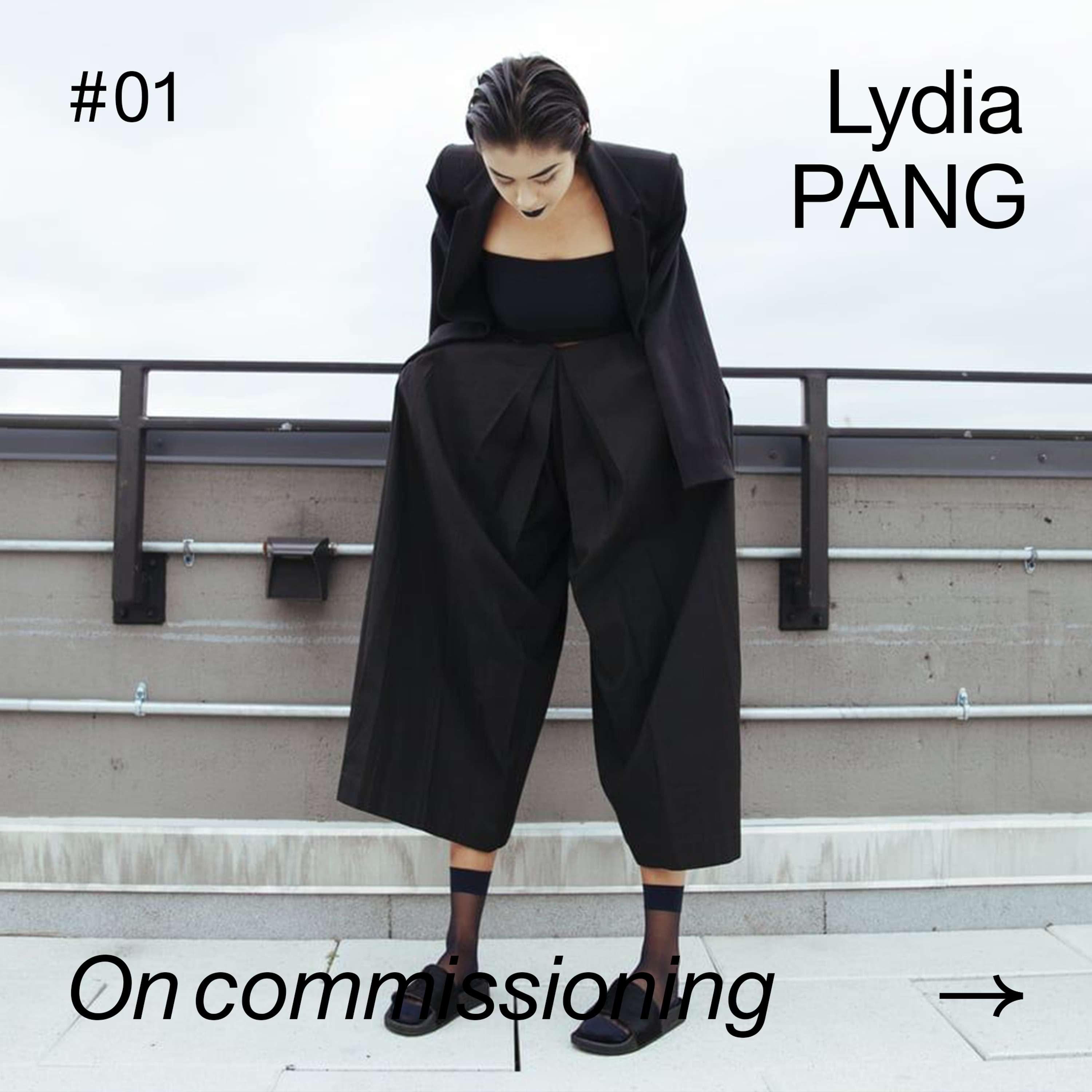
Lydia pang image from a Messy Truth (Fletcher, 2019)
What a positive podcast! Reflecting on the interview with Lydia Pang on commissioning. She captivated me from the moment she started and presented a world and attitude that made me wish I was 40 years younger.
However, its never too late and advice like this is invaluable.
I am a “baby boomer” and started my working career where guilds were still around and your path to become a professional was through a strict programme and apprenticeship. You had to apply for work or commissions and submit your certificates/degrees and testimonials from someone in that industry did psychometric testing and had an interview before getting a job or contract that will allow you to be commissioned for work.
The world has changed and Lydia’s description of it is done in a positive way without discounting the problems of our time. She presented how creative millennial and post-millennial engage with a career and get commissions. The internet, social media and professional sites such as Linkedin, number of people trained and able to do the work has changed how all people including creatives find work or commissions or rather get found. the following is my interpretation of her podcast (Fletcher, 2019).
Almost every statement she made resulted in a mind-shift for me. And that is why I list them here for a personal record. My main takeaways from this podcast are:
“When starting out, do as much as you can so you can find out what you don’t like doing.” She described how she interned where she could before and after UNI to see where she fit in the visual arts space. She freed herself from being defined as a photographer only by taking on other Photographic Roles and trying things that add to her value as a visual arts specialist such as copywriting etc. It reinforces the fact that we are all individuals that can bring a variety of skills and knowledge to a creative project. We can also use each project or internship to develop other skills or play a different role within that group. This advice is still wise for a 60-year-old starting out on a new career as a full-time photographer/creative.
Select the companies you identify with and bring you growth. Lydia identified the companies she wanted to work for and tried to find creative ways to get into them. Even tried to get a job as an account manager at M&C Saatchi Abel which led her to get a job in the ART department. Once I decide on what I want to commit to I need to identify and engage with enterprises that will allow me to grow even as a freelancer.
Find your own voice in the industry. We all have something to say visually. It s finding a way to bring that forward and having you heard.
Visibility is attained by disrupting to get commissions in the industry where there is so much sameness and is achieved through the adaption to use the new channels and mediums we are now making for, developing your brand, curating your work, and running and show up in a meaningful way in these platforms.
“Every Link is created equal” so put yourself out there, a good portfolio and work will be seen even if there are many photographers out there. When researching where this quote has come from I discovered a contradiction to this statement that all links are not equal (Shepard, 2019). But it does not take away from what Lydia intended to say. We all have an equal opportunity to present our work. There is sort of democratization of the ability to present your work. The difference is what you post, need to be authentic you, and if your work is relevant, interesting and your content can draw people in the agencies will find you. The contrary article really enforces that you need to know and understand the media channels, how they work and how to effectively use it to channel the potential commissioner or art director to your work.
You need to learn how to tell powerful stories on the internet platforms that the brands you need to do work for will use: This important statement was made by Gem Fletcher. These are no longer new platforms. Big billboards are no longer the primary advertising media. I agree with Lydia’s statement that we need to learn how to manipulate and innovate the creative use of these platforms. With reference to her mother, a photographer, she commented on how she at 50 has learned to adopt these platforms to get her presence and voice doing so through observation and seeking out research.
Authenticity! Add agencies are not looking for “Rock stars” anymore but authenticity creatives. They are looking for creatives that relate and show passion to the message or story they wish to convey in their projects. So you need to be clear on this in your work. It is important to present your passions, be it woman’s rights, social injustice etc. Your point of view and unique way of presenting in an image is important. It clearly transparent to them if you try and imitate or follow in the footsteps of others. There are some many images to choose from. They always seek something new. Something that shows that you have emerged into it.
Together we are stronger. There is a shift in identifying ourselves as creatives and collectives. as many voices with different perspectives…We are not islands anymore, more about the need to be very confident in your contribution to share it. Still, the pressure to attach credit to your work. But creativity doesn’t work that way. its a new learning curve for all of us. Initially, your impostor syndrome will be F… intense.
I discussed this podcast with my daughter that is currently in her second year studying a BA in interior design at Vega. Being a millennial and an active and knowledgeable user of the social media platforms she confirmed the statements above as being very relevant. Their course and assignment promote collaboration and the concept of a collective. They need to engage with each other and finding their voice in those interactions are extremely tough at times as many designers are competitive and want to make their mark. Initially, it went pretty well but in their last assignment, one of the designers dominated the project and in spite of advice from all the others forced her point of view on the others. It turns out that all this ignored advice was exactly what was pointed out by the lecturer as flaws in their project. The relationships are still strained and they will see if the lesson will improve and inform their work in the next collaborative assignment which is starting now.
This blog really motivated the need for me to participate in the collaborative exercise of developing a pitch to the clients as proposed in the course. Every opportunity to engage in a collective and learn to work with other creatives must be passionately pursued as the process cannot be taught but need to be experienced. I feel encouraged to participate fully.
While the context may differ, I believe the information contained in Lydia’s blog will shape how I view my client base, my portfolio and my point of view and the methods I need to use to solicit commissions in the future and I can immediately apply and test it it to my current practice as a wedding photographer and the MA course.
Respected African leaders, such as Nelson Mandela, Archbishop Desmond Tutu and Robert Sobukwe, championed the cause of the African Philosophy of Ubuntu, “a person is a person through other persons (Shutte, 1993)”, as the solution to resolve the major issues of inequality, poverty and dehumanisation of all people in South Africa. My intent is to critically investigate the impact of this philosophy in series of images.
“Photography has always been fascinated by social heights and lower depths. Documentarists prefer the latter. For more than a century photographer have been hovering about the oppressed, in attendance at scenes of violence with a spectacularly good conscience. Social misery has inspired the comfortably-off with the urge to take pictures, the gentlest of predations, in order to document a hidden reality, that is, a reality hidden from them (Sontag, 2005, p. 42).”
Sontag’s negative observation made in 1974 is still relevant and arguably informed by the socio-political-documentary photography in this period. Many journalists and documentary photographers gained photographic “immortality” and “fame” as they engaged in documenting the social injustice, suffering and struggle of the non-white communities in South Africa between the 1960’s and 1980’s. In spite of this, it managed to serve a moral purpose.
Another of Sontag’s critical observations was also upheld.
“Photographs may be more memorable than moving images, because they are a neat slice of time, not a flow (Sontag, 2005, p. 11).”
Figure 1. Hector Pieterson being carried by Mbuyisa Makhubo. His sister, Antoinette, runs beside them (Nzima, 1976)
The Journalistic and documentary photograph was used to promote support for the anti-apartheid movement and there are many memorable moments permanently captured in the minds of many via photographs of the South African experience.
Who will forget this tragic image of the shooting of Hector Peterson that arguably changed the mind of any further international support for the Apartheid regime.
It also divided Afrikaner unity…
“A careful chronological reading of his (Gerrit Viljoen, the rector of the Rand Afrikaans University and the head of the Broederbond in 1976 ) published speeches suggests a fundamental shift took place in his thinking after July 1976 student revolt, as a sort of protest, had revealed to him the bankruptcy of Verwoerd’s claim that black urbanisation would be turned around during the 1970s… the actual significance of Blood River lay not in the Voortrekkers’ physical survival against Zulu attack but rather in the values and culture they represented.
Four sets of values were paramount, he argued:
the political values of freedom for all nations;
the economic values of the Protestant ethic;
a fundamental (Christian-based) humanity in dealings with other nations and persons;
and a rich spiritual life of cultural appreciation and open, critical conversation.
Viljoen admitted this was an idealisation. Basic humanity had been transgressed, he conceded, in job reservation, the application of the Group Areas Act, migrant labour, the quality of life in black townships and the handling of political prisoners, but these issues were being raised and debated. One might well wonder what remains of Afrikaner ‘Christian humanity’ after this list (Moodie, 2017).”
However, documentary photography is more than photojournalism. It’s the documentary photographer’s “interest in capturing a living record of extraordinary people, places and stories that emerge from creative treatment of actualities (Franklin, 2014, p. 9).
In South African documentary photography, the oppression resulted in a new approach to documentary photography called:” Resistance or struggle” photography. South African documentary photographers decided that they “were not above the struggle for change, but part of it”. Photographers in this genre include Omar Badsha, Paul Weinberg, Albie Sachs, and Guy Tillim. (Krantz, 2008). However, there was not complete consensus among documentary photographers
“David Goldblatt, South Africa’s pre-eminent documentary photographer, voiced the contrary position observing that ‘the camera was not a machine-gun and that photographers shouldn’t confuse their response to the politics of the country with their role as photographers’. Photographers required a degree of dispassion. They should not deliberately seek to be positive or negative, but should attempt to convey the reality of things, with all its attendant complexity. ( (Krantz, 2008)”
Resistance and Struggle photography was fulfilled when Apartheid was abolished, the criminalisation of apartheid and the handover of power to a black majority government.
While there have been some movement, it must be stressed that abject poverty, dehumanization of people, injustice, violence, and corruption persist.
Omar Badsha reflects: “I was told by an Old man from Amouti: ‘Take your pictures, show the world the how we black people are forced to live. But don’t show too much suffering. It makes those in power angry. No one likes to be shown the results of their stupidity and neglect! But if you are brave then you must tell the truth.’” (Badsha, et al., 1985)
It is tragic that this statement is still true despite the change in political power, and the dismantling of Apartheid. But international interest in the challenges South Africa disappeared due to the “normalization”. South Africa has become just one of many postcolonial African States with similar issues. And the Sontag’s Flâneurs disappeared.
Nelson Mandell made this prophetic call at a union meeting: “Power corrupts. Anybody is corrupted by power, can be corrupted by power. And a society should have means of ensuring that power will not corrupt those you have put in power. And one of the ways of ensuring that does not happen is for you to be critical, to be alert, to be vigilant.” (Africa Check, 2019) It is as if he posthumous calls documentary photographers into action.
While, in my view, there is no need for resistance or struggle documentary photography, there is still an urgent need for socio documentary photographers to act as prophets. This practice is not spurned on by sensation and funded by newspapers. And we need to look for ways to make it relevant. South Africa require David Goldblatt style of Socio-political commentators and if done well may, as in the case of the Americans like Dorothy Lange, Walker Evans and Robert Frank be able to re-establish the importance and value of Photojournalist and Documentary Photographers.
Whether we can make a difference is a matter of debate, but I conclude with this background statement By Susan Sontag: “Photographs cannot create a moral position, but they can reinforce one-and can help build a nascent one. (Sontag, 2005, p. 11)
Franklin, S., 2014. The documentary Impulse. s.l.:PHAIDON.
Kleinman, P., 2013. philosophy 101. Avon: F&W Media Inc.
Krantz, D. L., 2008. Politics and Photography in Apartheid South Africa. History of Photography.
Krotopken, P., n.d. Mutual Aid: A Factor of Evolution. [Online].
Louw, D. J., 1999. Towards a decolonized assessment of the religious other.. South African Journal of Philosophy 18 (4):390-407.
Moodie, D. T., 2017. Vicisstitudes of the National Question: Afrikaner Style. In: E. Webster & K. Pampallis, eds. The Unresolved National Question. Johannesburg: Wits University Press, pp. P 227- p 228.
Paul recommended the Mutual Aid book by Peter Kropotkin, and I have been reading. It does inform the position from a modernist thinking point of view. It is what aid means to a capitalist where I see a disconnect. Kropotkin refers to mutual support and I think that is more in line with what I am looking for. Ubuntu is more about social responsibility rather than optional almsgiving…
What I am going to say now may be controversial so please bear with me. The Afrikaners were Calvinist and this thought was embedded in their ethic – refer to the Swiss. Calvinism originated there and influenced the Dutch philosophies and ethics which traveled to the Cape. Social Responsibility and Mutual aid were embedded in terms such as “menslikheid”(translated directly means being a human being) and “gasvryheid” (hospitality). However, Post-war poverty, industrialisation and urbanisation of the Afrikaner lead to unhealthy selfishness and internal focus. It lead in aspirations of upliftment for the Afrikaner people. Exclusive Mutual aid… It worked… but the Exclusiveness of this mutual aid was the major issue. in less than 20 years the Afrikaner and other Europeans experienced growth and strength. While some mutual aid did cross the line it was insufficient. The way I was taught “Separate Development” meant that all people needed to be developed but due to disparity and between levels of urbanisation and education, they thought this had to be done at different rates of change. However, this principle warped when the Afrikaner was corrupted with political and financial power and of course racist views that were common in South Africa at that time (Dutch (Afrikaners), English, French and Germans colonialists).
I have the same concern for the new South Africa: that Ubuntu will similarly be misdirected by those in power for capital and racist goals. I fear a new form of apartheid or nationalism. i.e. discrimination between European, Eastern and African or even nationalism. Even Ubuntu does not discriminate on the basis of race or nationality. Neither did Calvinism. Looking past the errors of the apartheid system there were programmes that were implemented by the apartheid government that, if applied or re purposed will help the new South Africa. If South Africa can apply mutual support to all as described by Ubuntu and Peter Kropotkin, in the same way, we will survive the future. In that, I agree with Peter. Urbanisation was not the survival of the fittest. It is the week organising in a way that aims prosperity for all.
Getting back to my photography I will be covering these issues in photographs in my project and in a small way help to keep the process on track. I know it it is idealistic. I know that most post-modern artists seem pessimistic. But the artist has been known to provide a vision of a way forward or at least act as a prophet by comparing intent versus reality.
My most Controversial Photograph on the Course so far!
“I am” -Model taking a selfie at the Photography and Film experience at Kyalami Midrand.
During Webinar Week 9. Thursday 1st August. 2019. 1600-1730hrs BST (GMT+1) I presented my peers and our tutor this photograph with the assumption that they understood where I was coming from. Wrong….
Generally I did not understand my audience and I they did not understand the context of my photograph. Part of it may be due to a discussion that took place before I joined, where abuse by two dominant males was discussed and secondly not all have seen my presentation.
It was interesting how what I saw differed from what people see when they view this photograph. And yes, it is about context and audience. How you prepare your audience and share the photographs does influence the way they experience it. But you may have a photograph that cannot be contained within its original context… This is a good example of that.
Lets first explain the context within which I took this photograph. As a person, I am predominately driven by western modernity. That means I am influenced by that philosophy. This photograph intended to show how the Cartesian Cogito, ergo Sum negatively influenced western philosophy. Making the individual the centre of all truth.
As part of that project I want to change my gaze to see other philosophies interacting on my world. In my world both philosophies exist and influence the economy, art and politics and even individuals.
I attended a Film and Photography Experience expo where, apart from the workshops and expo areas, various practical shooting areas was set-up for photographers to use or try out various camera equipment. When I passed through this particular area I took one photograph of a young model posing next to a car merely as a composition and colour exercise when the above photograph happened. A photographer was done shooting the model and car and as she relaxed, the model took out her cellphone, kneeled down and started taking a selphy of herself. I realized that I am seeing a very self absorbed moment where the model was focusing on herself in front of the car which in my mind represented the abuse of modern/post modern use of the “I am”. I can never be sure what of her actual thought or motivations.
However, I had four people viewing the photograph. My tutor at first saw the photograph as the model angrily photographing the photographer and it brought up that the photograph brought up many topics – using sex to sell? which side tracked my intent.
One of my fellow students and passionate champion for feminine and children rights raised that in her mind it presented the exploitation of the model. And I must admit my response was typically that of a male photographer, so I won’t venture into that. She saw something that was way off from what I saw.
Another student with whom I have been engaging reviewed my oral presentation and could reflect immediately on what I saw.
It does speak to how we see the world. Our photographic gaze!
When I showed the second set, we aligned a bit more and we started to discuss what I was intending with my project. I had the feeling that even Paul had a problem understanding where I was coming from but we did reach a touch point when he suggested I read.
When I showed the second set, we aligned a bit more and we started to discuss what I was intending with my project. I had the feeling that even Paul had a problem understanding where I was coming from but we did reach a touch point when he suggested I read Pëtr Kropotkin Mutual Aid: A Factor of Evolution.
Just to reflect on something important regarding Ubuntu. The western concept of aid means the great I am…. help others. Ubuntu is bigger than that. Your humanness is defined by the way you treat those that require your support. Pëtr Kropotkin uses two terms Mutual aid and Mutual support. I believe the “mutual” part is more in line with the Philosophy of Ubuntu.
Nelson Mandela stated: it takes a village to raise a kid. Those of us in happy families knows that being able to support a happy family does raise your self steam and sense of being, especially if you do it because you are a human being not because you feel obligated to do so. The well known Jewish Rabbi, Jeshua, promoted this oneness, the love driven support to all our neighbors. As in the case of the the Hawain Ho’oponopono, and the Jewish Mensch, it promotes that the person that support others is the also a beneficiary or gets the healing. The become complete and balanced individuals or get healed. The Hindu faith and Budism embeds this connectedness. We forget that modernity raised multiple ideologies which either reject these philosophies or supports it. e.g. Socialism and capitalism.
In conclussion
It was recommended that I don’t use this photograph as part of my submission as it distracts people from my intent.
After thinking about it a bit more I decided I will use it. The reactions reflected a paternal post modernist view in it’s own. I however altered it to try and eliminate the alternative readings.
In my opinion, it is also a worthy picture to use in my teachings in the future without any comment to illustrate the principles of interpretation of a photograph.
The First semester is gone. Time to reflect on it all….
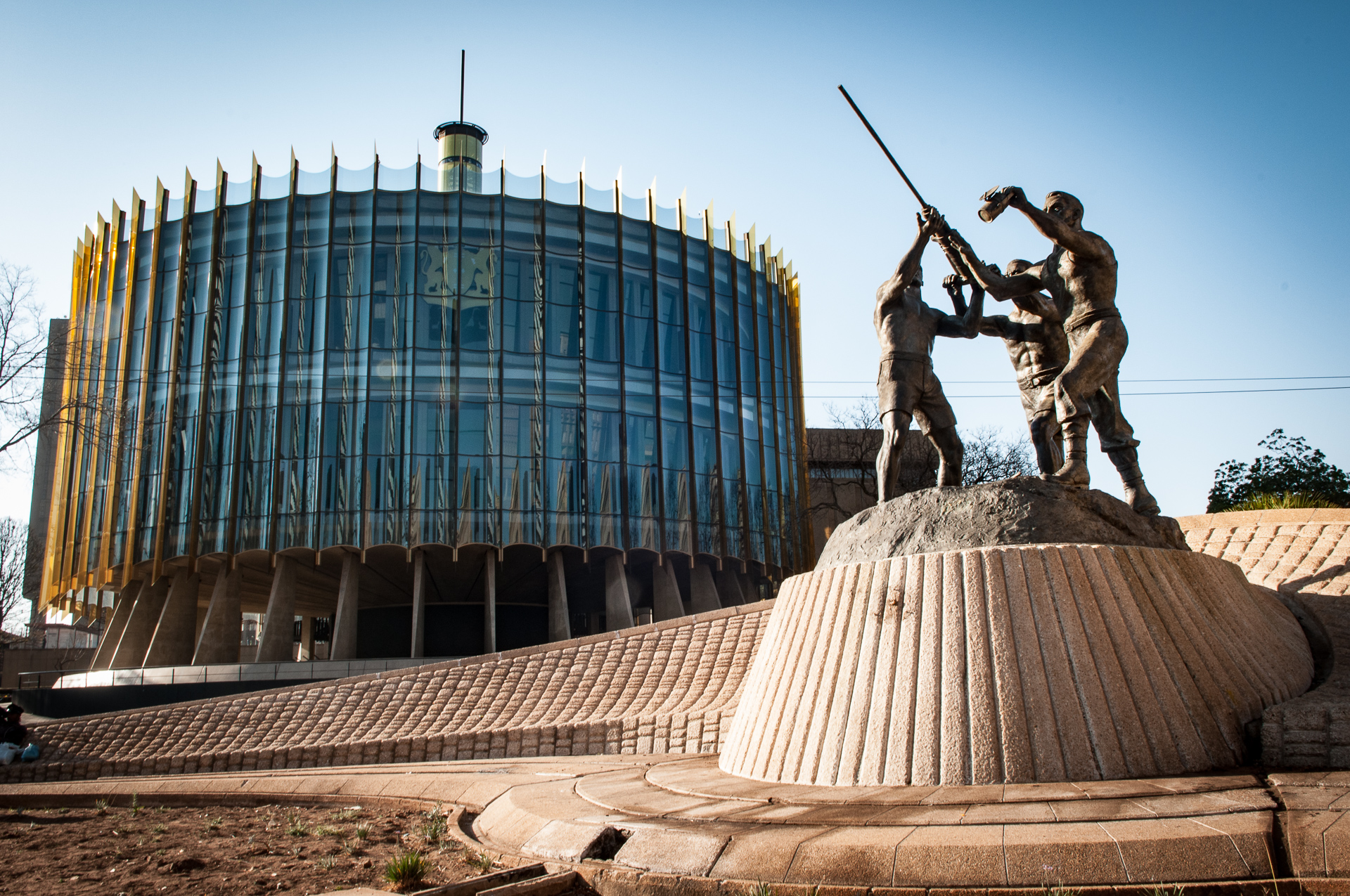
(Andre Nagel 2019) Statue honoring the Miners of both African and European decent, back dropped by the New Johannesburg Council Hall, a symbol equality and common sharing. Symbols of Synergy between Modern Mining and African Mining.
For me this semester was most definitely a decision to select my practice and positioning myself as a contemporary documentary photographer . However, it was never easy for me. In Brassaii’s words: “I’ve always hated specialisation. That’s why I constantly changed the medium I express myself…that way I can breath, I can see things anew (Gautrand, 2008 p 9).”
I realized at the outset that I needed to select a specific “practice”/ genre that I want to use to grow . I have done many personal projects ranging from landscape, abstracts, flowers, portraiture, wedding and events and other “eye candy” work. I definitely did not want to socio-political documentary. I even stated that to my on line tutor, Paul. But that intent was short lived.
When I started the program I wanted to break away from my past. I did not want to engage with a political agenda. I just wanted a “normal” project. But this changed when I was challenged by the reading work from “Practices of looking” (Sturken and Cartwright, n.d.). This monograph highlighted that my gaze as a photographer may be from a Paternalistic Western view and that I may not be able to see other original philosophies prevalent in my context as a South African. I knew I wanted to pursue the Documentary photography practice from the start, but thought I can get away with a simplistic subject. This was not to be…
My Oral presentation became a deep self analysis, and from it was borne a need to investigate the post apartheid South Africa and the collision between unpopular and sometimes condescending Colonial philosophies and Ubuntu, believed by many to be the answer to South Africa’s challenges. And I started on a journey of discovery far beyond my expectations of the course.
In an earlier blog I mentioned that I no longer wanted to define myself as white and South African, but I have discovered that it is not easy to break those bindings. I discovered how I am entwined in the knowledge of major socio-political issues still prevalent in South Africa. I found myself being alien to the challenges of my peers to the extend that I was alienating myself from them.
Reading “On Photography (Sontag, 2014)” I came to realize how unpopular the practice of documentary photography has become, reinforced by the inability to ensure the delivery of “truth” with the arrival of the digital age. (Ritchin, 2013)
That being said, I also found a diamond where Darren Newbury quote Susan Sontag at the “Photography, Politics and Ethics seminar”, held in Johannesburg in 2004, where she talked about being struck by a strong moral and ethical dimension within South African Photography and the attention given to the politics of photography (Newbury, 2009). This has made me realise that I have an obligation to attempt to uphold such a standard.
One of the most important things I did discover is in my picture taking. I needed to learn to detach myself my believe systems and opinions. I needed to become dispassionate with my subject matter, following in the path of my favorite documentary photographer, David GoldBlatt.
I started reviewing the work by my favorite photographic mentors and among of all the gold nuggets I found a mantra to work towards during the coming semesters: Don’t be a Thief; don’t take people by force. (Gautrand 2008 p9)
I will also pursue the following as a creative principle: “There are two gifts which every man of images needs to be a true creator: a certain sensitivity to life, to living things, and at the same time, the art which will enable him to capture that life in a certain specific way. I’m not talking about pure aesthetics: a confused photo isn’t capable to penetrate the the viewers memory. I’ve always felt that the formal structure of a photo, its composition, was just as important as the subject itself… you have to eliminate every superfluous element, you have to guide your own gaze with a strong will. you have to take the viewers gaze, and lead it to what is interesting“- Brassai (Gautrand 2008, P 12) .
References
Gautrand, J. (2008). Brassaï, Paris, 1899-1984. Köln: Taschen.
Newbury, D. (2009). Defiant Images Photography and Apartheid South Africa. 2nd ed. Pretoria: Unisa Press.
Ritchin, F. (2013). Bending the frame. New York: Aperture Foundation, Inc.
Sontag, S. (2014). On photography. New York, NY: Picador [u.a.].
Oral Presentation for Position and Practice By Andre Nagel
Transcription of Video
Slide 1
Slide 2
My name is Andre Nagel and I consider myself to be a “Light Scribe…. “
Let me explain.
Slide 3
This photograph, by Gary Winogrand (Winogrand, 1969), resonate with me and my past in so many ways. The little boy on the bench looking at the world represents me. I was 10 years old when this picture was taken.
Slide 4 and 5
Ever since I opened my eyes to the world I was fascinated by light, shapes, lines, form, texture, the people and the world around me. From the start I felt the urge to talk and tell stories using pictures and build visual models in my head when describing complex theories.
At first, I just wanted to, as Gary Winogrant asserts, “see how something looked Photographed. (Directive, 2019).”
Slide 6
This is one of my earliest Photographs. I was learning to see light. The soft focus and reflection in the eyes have a certain dreaminess,and in this I see myself reflected in this picture. My teachers always said I was a dreamer.
It was my first attempt at doing a “Rembrandt” using window light. I can’t remember, but I was possibly reflecting Art works that my Dad shared with me. Today I see a bit of Julia Margret Cameron in it too.
Slide 7
I took this image of my cat, backlit with my study lamp in
1979.
A photograph reminisced of Brassaii’s Paris at night. However, for me it reflects on a time I deliberately removed myself from general societal issues.
I no longer involved myself with the lives of any communities outside the perimeter of my protected life of relative bliss; deciding that I had too much of politics and violence in my military years, I immersed myself into my studies, starting my own career and finding love.
However, The Poem by Rod Mckuen I added into my album, amplify how I felt about myself at that time. Especially the line: “I do not live within a lie. Because I do not live at all (Mcheuen, 1972).”
Before finding love of course…
Slide 8
In the same way this photograph haunted me. “As If I we needed something else to worry about. ” This is a quote from “A Tree of wooden glogg’s , 1978”. A film by Ermanno Olmi , which I saw in 1979.
It was a story about Young love, getting new clogs for the son, slaughtering the pig, and daily laboring in the fields, while being oblivious to the outside world, where the Italian revolution raged.
It’s exactly how I lived!
Ironically, this photograph juxtaposes the wealthy and the
poor embracing each other.
Slide 9 and 10
Franklin in his book; “The documentary impulse”, write that “the documentary impulse is about human experience in all its range and complexities (Franklin , 2014).”
The impulse to document my life and that of those around me is prevalent in most of my photography.
I strive “to describe the world as I see it with my naked eye (Franklin, 2014).”
Slide 11
At first, I did not know how to define my photography, but two years ago, when doing the course: “Looking at Photographs” with the Museum of Modern Art, I realized that I have been primarily taking documentary photographs.
To Illustrate briefly, I present one of my photographs from a series I took while visiting Turkey in 2000. I used the repetition of the obelisk and towers to accentuate my sense of the intertwining of Egyptian, Roman and Turkish Histories and architectures.I missed the top of the obelisk because I used a 35mm Instamatic Camera.
Slide 12,
13
As part of my personal growth I started to study Theology and Philosophy. This introduced me to critical thinking, I found that things were changing in me at a deeper level and the way I see the world…
Some may call this the “dark night of my soul.” I died to my egotistical self.
As St John of the cross wrote in the last stanza of his Poem
“I abandoned and forgot myself,
laying my
face on my Beloved;
all things
ceased; I went out from myself,
leaving my cares ( The Value of Sparrows, 2019) ”
Slide 14, 15
This led me into a new phase of my photography. I was looking deeper…
It is what David DuCheman says: “When we look at our photographs and find not the slightest reflection of ourselves, it’s a good sign that our images have lost their souls (Duchemin, 2019).”
Slide 16,17,18,19
The digital age arrived, and my wedding business expanded at a rapid pace.
This new learnings,and the experience with some Social documentary work I did for the church, taught me storytelling, which found its way into my wedding photographs and my popularity increased.
My personal research led me to investigate ways in which I can make my photography more significant and to re-establish the links to my artistic self.
Slide 20,21
This newfound passion for photography, and the effort to develop myself made me realize how much I had to offer as an art and photography teacher.
As Frank Oppenheimer said: “The best way to learn is to teach (Oppenheimer 2019)!”
I developed training courses for amateurs and, in a way, this was my informal tertiary education. I was being inspired by the practices and photographs of the masters I was now referencing in my courses.
slide 22,23,24
As Desmond Tutu said:
“We are all connected. What unites us is our common humanity. I don’t want to oversimplify things, but the suffering of a mother who has lost her child is not dependent on her nationality, ethnicity or religion. White, black, rich, poor, Christian, Muslim or Jew – pain is pain – joy is joy-(Huffington post, 2019).”
At first, I mentally changed my nationality from “Afrikaner”
to “South African”.
In my mind I would no longer associate myself with a
specific group being defined by race, creed or religion.
Taking a position require you to draw lines…“apartheid!”
More recently I have decided to even relinquish my position as a South African. I have become Egalitarian
Note
I removed the following due to time constraints. < I am… just me. And you are just you…. No need for pretense to be accepted. Like every sparrow I am special to God or if you prefer the Universe. A Unique person, living in a world of special and unique people.>
Slide 25
This is a photograph taken at a retired apartheid Police general’s funeral. It was attended by Rightwing AWB members and his ex-colleagues; some which happened to be African. All unified in grief.
This new freedom from the constraints of my ego; conforming to someone else’s views on politics, nationalism, religion, and economics allow me to see people as people.
Slide 26
South African’s love sport. This moment was captured during the celebration of Wade Van Niekerk’s World record. The diversity of people celebrating the event, standing on a stairway, seem to celebrate our ascension from our past.
Slide 27
For my project I propose to use the Hegelian Dialectic as a basis to describe through images, our current societal development documenting the resolution of the conflict between Western Modernity and African Ubuntu.
I am heavily influenced by, what Sturken and Cartrwright describe as Colonial modernism or Paternal Modernity.
As a descendant from Europe, I tend to consider it better than any other philosophies.
The theory is that if Western Modernity was and is still seen as superior and influenced us, and keeps on influencing us, then I am a product of that philosophical system.
It presents the thesis of society before the handover of political
power in South Africa in 1985
Slide 28
To explain: Using architecture as a theme.
This is the head office of Sasol – Originally a parastatal company created during the Apartheid era, to overcome the embargo on fuel by producing oil from Coal.
A Symbol of progress
through Science.
Today they provide labor to over thirty-one thousand people
in thirty two Countries.
Slide 29
“In Southern Africa we have a concept called Ubuntu – which is that you can’t exist as a human being in isolation. You can’t be human all by yourself. We think of ourselves far too frequently as just individuals, separated from one another, whereas what you do, what I do, affects the whole world. Taking that a step further, when you do good, it spreads that goodness; it is for the whole of humanity. When you suffer or cause suffering, humanity is diminished as a result (Desmond Tutu, Huffpost.com, 2019)”.
The anti-thesis is the African philosophy of Ubuntu, a Zulu word meaning “Humanity”. It has been prominent in the minds of African people, but I want to learn to see how they see it.
I want to capture this anti-thesis in my images.
It may allow me to change my gaze to something that is
unfamiliar to me.
Slide 30
This is an architectural drawing of the Ubuntu center in the Zwide Township, Mandela Bay.
The Ubuntu centre currently feeds 2,000 poor children each day, provides holistic support to 3,500 clients and their families, delivers after-school education to 250 students, and issues HIV counselling and testing to 6,000.
Slide 31
If the Hegelian dialectic is a valid approach, then one can expect a natural synthesis of the two philosophies where conflicts will be resolved, and a new thesis be developed that is uniquely South African.
I want to also investigate if I can observe this synthesis
in my photographs
Slide 32
This architectural drawing is of the latest retail space in
Midrand.
“The Mall of Africa.”
It provides 485,000 Square metres of space, the shopping space itself is “only” 131,000 squares.”
Slide 33
This is a view of the Western Gateway, a post-Industrial building, at the main entrance of the mall.
“Here is a tree rooted in African soil, nourished with waters from the rivers of Afrika. Come and sit under its shade and become, with us, the leaves of the same branch and the branches of the same tree- Robert Sobukwe (Sobukwe, 2019).”
This image not only stimulate my visual senses through the aesthetics and lines but fills me with an excitement. My children may still have a beautiful future ahead of them!
Slide 34
I realize that a work of this magnitude could take more than a lifetime. And I have little of that left….
So I will address themes in workable chunks clearly demarcating the scope to achieve the desired outcome. The depth of my research will depend on time constraints and my commitment to the task. But the work can be done iteratively with each cycle building on the other. ..
In this semester I will open my photographic eye and do an initial photographic survey, critically read Franklins book “the documentary impulse”, and scholarly works on Ubuntu. I will also attempt to identify knowledgeable collaborators to assist me in reviewing my future work.
I will record my
findings and determine which themes I want to pursue in the other
semesters.
As my ultimate intention is to teach, I will also focus my research on the documentary approach and aim to prepare for a workshop to share my learnings at the end of the MA.
And if I am successful do my first exhibition in South
Africa.
I believe that I need to do this, and keep on doing it,
to improve my practice and to progress from a successful to
a significant documentary photographer within a contemporary South African
context.
And maybe do some penance for my ignorance in the process.
Slide 35
I conclude in the words of David DuChemin:
“The camera on its own is a wonder, but in the hands of the poet, the storyteller, the change seeker, or the frustrated artist, it can create something alive that touches humanity (DuChemin, 2019).”
Slide 36,37,38,39
References
Bibliography
Franklin, S. (2014). The documentary impulse. Sturken, M. and Cartwright, L. (n.d.). Practices of looking. Oxford University Press, pp.95,96. Versace, V. ca (2007), “Welcome to Oz: A Cinematic Approach to Digital Still Photography”. Kleinman, P. (2013), Philosophy 101 pp.108,109,110. McKuen, R. (1972). To every Season. 1st ed. Simon and Schuster.
Film
The tree of wooden Glogs. (1978). [film] Directed by E. Olmi. Italy: RAI Radiotelevisione Italiana, Italnoleggio Cinematografico.
Reflection on my readings and the impact on my Project.
“The Photographers Gaze” By Andre Nagel.
We are almost halfway in the semester and I can honestly say that I am only getting a handle of the course now. This weeks content had the greatest impact in my mind. It takes time for one to assimilate, internalize and synthesize information and in this week it all sort of came together. Such a shift changes you as an individual.
My mind shift occurred while reading Marita Sturken and Lisa Cartwright’s “Practices of looking: An Introduction to visual culture (spectatorship and power)” and specifically the section “The Subject of Modernity” (Sturken,M and Cartwright, L : p94).
It changed the way I will approach my project and me trying to find myself in a post-corporate role. I agree with the authors that to understand our role as image creators we need to understand ourselves, the subjects gazing at the image after I have taken it , the people gazing at me in the image and the context of the “field” as defined in text. I believe that doing so will improve my interpretation and understanding of my own images and and has the potential to take my documentary photography “From success to significance”.
The article impressed me as it uses philosophy and modernity as the point of departure in this introduction to visual studies.
However, what surprised me was the I had an epiphany in the realization that much of what is happening in South Africa ( a Ex-European colony), in the newly “liberated” or freed society may be explained in the following profound portion from the text. “These colonial strategies of modernization were justified by the Eurocentric belief that European practices and beliefs were objectively better (more advanced, more sanitary, more ethical , more modern) than the cultural practices and ways of knowing and living in the world that had been in place prior to colonization.” (Sturken, M and Cartwright, L : p95, p96). I believe that it is that lead to supremacist views, racism in the colonies and finally “segregation” and “Apartheid”.
To be effective I need to see how much of this is these views are in-bedded in my thoughts. I know that in certain ways I still hold some of these believes.And I am still a male….
About a year ago my best friend, who happen to be a coloured, accused me of wanting to enforce my western ethics onto Africans. My simple answer to him was, ethics are ethics… Its important to know that my dad was a liberal that grew up in a integrated society in Observarory Cape Town and we were taught to respect all people irrespective of their race, colour or creed.
A second thing I came to realise when photographing Black brides I found that I could not view them as I do white women even if they followed western traditions. Facing this realization made me change the way I look (Gaze) at these pretty woman and my photographs normalized as they started to gaze back at me differently. This activity within myself improved my photographs and I can now relate fully with the individuals. But I know I am still a work in progress.
The impact of Modernity in South Africa is also a work in progress.
Modernist thinking led to the Dutch to travel around the Cape of Good Hope finding a route to India. The early Dutch and French settlers came from a stock that fought for their convictions and had to flee to the Cape province to avoid persecution. As in the case of the early Americans they fled the imperial aspirations of European monarchy and in the case of the British settlers, poverty and injustice in England. There aspirations driven by modernist ideals and led them to create two independent republics separate from their mother countries.
Jumping ahead to the 20th Centuray, Our founders and political leaders were well educated in western philosophy, rational thinking, science and and modernist view. Dr. D.F Malan the early protagonist for “separate development in the 40’s and 50’s, was trained through the Anglo/European Tersiary education systems at Victoria College (now klnown as Stellenbosch, where he earned a Bsc in Science and mathematics, did an MA in philosophy before getting his Bth and Doctorate in Theology (Koorts,L:P23).
Malan went to the same school and College as Jannie Smuts in his youth. (Koorts,L:P29). While Malan who did some of his education in the Netherlands during the Boer war is today seen as a racist, Jan Smuts who was 4 years older and Studied Law at Cambridge, and who fought against the British during the Boer war and with the Allied armies during world war 1 and II, turned out to be a romanticist, botanist, war hero that became a peacemaker and world leader. This is a story very similar to that of Nelson Mandela whose statue today stand next to that of Jan Smuts in Trafalgar square.
This is part of a discourse happening in my mind and those gazing with me at the new South Africa. This expands my image making process. There is a “now” to be recorded. Midrand, a vibrant and a developing city, nested between the Johannesburg , the center of commerce, mining and industry, and the Tswane (formally known as Pretoria), the center of our democracy as political power, is my home. It hosts the PAN African Parliament and most of the post industrial, technology companies. I am living in a cauldron of modernity that is affecting and shaping our society, religion, culture and economic lives. An ideal opportunity for me to document!
South African Artists tend to interpret what we gaze at South Africa through “Apartheid” and “Colonization” and “White/Non white glasses” but maybe we should expand this gaze and “Modernize” it when we interpret what is happening to us in global terms.
Putting it in the words of a Non-white South African:
“As we stand atop the political ruins of the Afrikaner nationalist project and, staring at the horizon, see in rough outline what looks like the makings of an African nationalist wreck, we might think there is nothing worth excavating from these ruins. But, as Lindie Koorts shows in this fascinating biography of D.F. Malan, there is much that South Africans, still have to learn about their collective past. She has produced a book that shows how one can go about writing a history that is understanding but not apologetic, sympathetic but not justificatory. Malan was not an evil man. He certainly meant to do right by poor whites and to achieve Afrikaner unity. But, and this is perhaps the most important lesson to take from this captivating book, Malan could not see beyond his narrow community interests. That, ultimately, was the greatest irony of Malan’s life.’ – Jacob Dlamini, author of Native Nostalgia and Categories of Persons (edited with Megan Jones) (Koorts, L:Afterword)
You may well ask why I reflect on this… It’s the incoherent “separate” and asynchronous way that the positive and negative sides of modernity has hit the different groups of people in South Africa and the collision of thoughts and discourses, that is reflected in my field of gaze and interest me. The introduction opened my eyes to see this in practical terms. And I now have the urge to develop this understanding my Gaze and the Field in my practice as a documentary photographer.
This discourse will form the basis of my oral presentation and as Paul suggested I need to verbalize it concisely and slice the effort into workable realistic chunks of work. Truly a challenge as my mind races towards a accomplishing a huge body of work that will probably take the rest of my lifetime to achieve.
Reflections on Ethical Discussions:
The Fisher Cohort started our discussion around the abuse and misinterpretation of a photograph by UKIP for political purposes. It was as far as I am concerned the best discussion so far.
I could see how the debate raged internally within each one of the participants, specifically Bekkie. I was not new to the debate and added my 10 cents worth which was well received.
My mind started to wander to ethics at a different level. I came to realize and acknowledge my personal responsibility as a photographer for the pictures I take and the story I tell. But this responsibility include the assignments we undertake to do and to whom and for what purpose we deliver their images to. We no longer can use the Nuremberg excuse. Issues that was discussed was copyright and publishing rights, codes of conduct and ethical standards. I also added that as photographers we need to take responsibility for our own business and make sure that the Law reflect our ethics by lobbying an fighting for justice and appropriate use of our works. This include social media and news and media agencies that can only be governed by Law.
The aforementioned discussion and the Alan Kurdi video brings to bear a need for a deeper analysis regarding ethics.
It chalenged me to reflect on other aspects of ethics such as our purpose to take a photograph, i.e the reason for our gaze as a photographer. Was the journalist taking the picture to make money? Or is the purpose fame and honour such as a pulitzer prize, Or commercial, merely wishing to produce shock for some agency to get legal tender to live. What responsibility and ethics was applied by not publishing it in certain countries and alternatively, which of the photographs was actually published? And lastly, the impact it has on us sitting in an environment of calm and peace viewing the horror of what is happening in the world desensitizing us to the truth out there.
For me the shock was the quality of the child’s clothes. He does not represent poor down trodden unwanted members of our society, but present modern, well loved and a well cared child, rejected by our society. I must declare that I too have become desensitized to the horror of famine, war and injustice in Africa. How did we react to the horor of the Ethopian Kids migrating in Africa.
The death of Alan Kurdi had a desired outcome and opened the door hearts of many countries to the Syrian refugees and their plight. Does the end justify the means?
It then brings into play the ethics of censorship. With reference to my in discussion on censorship in the Article in week 4 about of citizen journalism in the Boston marathon attack and the linked impact assessment where the American authorities wanted to switch of the cell service to reduce the impact of the story to the general public.I was also prevented from watching McCullen in South Africa. Was it a regional block or a censored video as it include black on black violence.
Just a general note. The group is mostly in agreement and unfortunately we are not really getting to debate differences of opinion. I see Paul raised some questions that could produce this outcome but unfortunately my time was up. In future I will see that if the opportunity arises that I will add an alternative perspective to the discussion and see if it produces a deeper outcome. In my opinion the group and myself has not broken the politeness barrier yet.
Reference: STRURKEN, Marita and CARTWRIGHT, Lisa. ca. 2001. “Practices of looking: An Introduction to Visual Culture.”
KOORTS, Lindie. ca. 2014. “DF Malan and the Rise of Afrikaner Nationalism”
“I Want to Swing” Work done during collaboration By Andre Nagel
Jessie in introduction lecture to this highlighted solitary pursuit of the photographer in ” the act of taking a photograph and the intimacy and exclusivity of the viewfinder, which usually allows just one person at a time to make judgments about framing and timing, that leads us to associate photography with a strongly singular point of view in terms of authorship.” or the freelance photographers “indeed work for themselves and conduct their business as sole traders, operating as a single entity.”
In my practice as a wedding photographer this may seem the case but it is not true. Even a sole proprietor my work requires me to collaborate with other service providers (videographers, DJ, etc) and our customers and to be able to record the event fully I require a second shooter and an assistant. This process lead to choreographed dance of interaction, shared creativity , timing and provisioning of space. Although I do my own post production work at this time a number of my peers make use of Photoshop specialists and graphic designers to finalize their vision with great effect.
This collaboration is required even in journalism where as in the Case of the Bang bang Club journalist hunt together for the story. In Fashion the collaboration occur between the photographer, stylist and creative director. and even as a amateur, it is better to collaborate with others to go out and find the perfect picture, even join photographic clubs.
I find that these collaboration brings about some competition and creative tension that lead, in my case to better work. In their Video tutorial ” ” Rocco Ancora and Ryan collaborate to teach and on occasion do work together. They formed a social media group with a number of wedding photographers to send each shared photos taken with cellphones on the back of their cameras to compete at who can get the best in Camera shot. According to them this resulted in them improving their skill to such a level that reduced their post production work immensely.
This week we were challenged to find a collaborator and deliver a presentation. I posted a group to participate in discovering “alternative portraits” and unfortunately did not manage to invite someone specific to join After 1 day I realized that I was not going to get someone and I contemplated joining one of the other teams. I fortunately decided not to do so and I advertised for participants to join by sending out a proper brief. This turned out to be a success when “Buzz” Christopher Matthews Joined me. It was a start of a pleasant journey and we managed to complete the task in one day. Unfortunately due to technical difficulties I could only submit our work two days after the webinar. I do feel that we both achieved our brief and each of can list at least one failed attempt. Our work was diverse with creativity being our only link.
Looking at the work done by some of our peers I came away with the impression that they all experienced the process positively and those that participated grew in trust and respect for each other.
On the question of authorship, it became less of an I and turned into a we as all parties influenced each other in one way or another.
In practical terms,it is best to consider signing agreements up front around copyright, intellectual property (ideas) and distribution rights. Beth and Thom Atkinson even illustrated what can be done if a shared authorship model is undertaken. As Beth said, it sometimes become impossible to remember who shot which photograph, something I experience regularly with my second shooter as we align in style and purpose. Fortunate the meta data on the photograph allows us to manage it.
Husband and wife and family teams abound the industry such as the Dianne and Olivier Follmi (French Travel Photographers), Bernhard “Bernd” Becher, and Hilla Becher (Famous for their water tower photographs) and the Van Den Berg’s (Heinrich van Den Berg and his family:South African wildlife Photographers ), to mention a few. In some cases no differentiation or separate accreditation are given for their work.



 André Nagel's Critical Research Journal


