For many years I have been working as a part-time professional Photographer in the wedding, event and portraiture industry. I had full-time employment as an IT professional. The purpose of commercial photographic work was mainly to support my private passion for photography and to be able to purchase high-end equipment for this passion. About 5 years ago this passion resulted in another income stream where I undertook to share my knowledge by teaching my skills to budding photographers through a set of focused classes. Up to that point I rarely shared my private work and “projects” being too sensitive to criticism. A shared artists problem… But my students encouraged me to break through this barrier.
Since July 2019 things changed for me. I was retired by my current employer at the age of 60 due to the slump in the IT industry. in 2018, knowing that this could become a reality, I started to investigate how I can convert my passion into a full-time photography career. I developed my business plan with the help of peers and training and research to determine what I needed to do to be able to convert to a full-time photographer by June 2019.
My research led me to various options., to become a full-time high-end wedding photographer, develop my skills to become a free-lance photographer or see if I can get into an education position. The latter being my preference. Most of my research informed me to split my vernacular and my artistic endeavours. I formally registered my photography business but separated myself as a Freelance Photographer and educator in a personal capacity. I believe that this would allow me to hire and train other photographers on a part-time or full-time basis to collaborate in my wedding business venture and keeping my personal brand as a photographer and educator separate.
From the outset, I decided to let the MA develop my personal brand and practice as opposed to the Wedding photography business focusing on documentary photography. Photographing weddings is extremely demanding and I don’t see myself doing it for more than 10 years. By then I should be able to sell the business or run it purely as a business owner. During Week 2 where we focused on other careers in Photography, I was introduced to the different levels of professional photography. It confirmed that if I apply what I am learning in this programme I can move myself to do projects at the corporate level and choosing endeavours and projects that I love without compromising my income.
That being said, my love for photography was never driven from a commercial intent but my love for the medium. Developing training material has led me to undertake personal projects. Most master photographers are acknowledged for their personal projects rather than their commercial work even if they were great at it. e.g. Cartier-Bresson, Brassai, Jay Maisel, David Goldblatt and many more. Personal projects kept them sane and committed to their work for there lifetimes. It is my resolve that the need to earn a legal tender won’t derail my path to express myself and kill my passion. I am still able to generate double my photographic income from part-time IT consulting, This enables me to be selective of commissions And allow me to focus my attention on worthwhile personal and commercial photography projects. the aim is to eventually free me from this “Golden cheque”. This income is also funding my MA. I aim to have this “long walk to freedom” co-inside with the completion of my MA.
I believe that I have developed my own style over time and continuously look for ways to improve and expand on it. Every subject has its own lessons to teach. and Personal projects and focused research has always paid off in my photography. Wedding photography has stolen has done what Michael Freeman predicted, The mundane and drive for income has stagnated my photography development and I need to as Jay Maisel recommend… “Walk slower” and learn again to appreciate and enjoy every click.
I start this discussion with a digression to reflect on what went through my mind during this exercise. The focus on my opinion is important here for indicative and reflective purposes.
Before listening to this podcast I viewed Alexander Coggins work on the internet and I was genuinely unimpressed. His overuse of on-camera flash in every shot gave me the impression that he never developed a proper skill. I was, and maybe still am, very judgemental. Yet Coggin owns it by proclaiming: “I love flash!”
The main reason for my reaction is that I am predominantly an available light photographer that rarely use flash, only in times that it is really needed and with a definite purpose. Like him, I am self-taught, and I developed my skill over many years but we seem to have taken different paths. I seek technical perfection… try to perfect exposure in-camera under many difficult conditions and then make fine adjustments in the digital darkroom. I was taught the skill by reading the books by Ansel Adams, Michael Freeman, and Chris Wesson and hours of work perfecting it in practice, learning and applying the zone system and exposing to the right, and then learned how to to use over and underexposure for creative purposes. And yet Coggin gets accolades because he consistently overexposes his images blowing out details he so vehemently says he wants to keep.
Due to my wedding photography work, I have learned to perfect the use of on-camera flash and off-camera flash, high key and low key photography and he can blatantly talk in disgust about others that use artificial light such as tungsten light. I often make use of the artificial lights in the room and adjust white balance. I use flash to fill in or augment the available light in the way that Annie Leibowitz does or sculpt my subject as Monty Zucker did. And Coggin use uncontrolled overpowering daylight flash all the time!
I did not develop these skills to copy the work of others but to learn how to use the skill to tell my story or present my aesthetic. At the age of 20, I was taught by Axel Bruch (in his book) how to compose simple and complex pictures in those and break the rules when I have a purpose. Ansel Adams taught me pre-visualisation and adjusting perspectives using lenses. I always look at composing my photographs in my own unique way. I even let intuition allow me to do so under rapid shooting opportunities such as street photography. I don’t know whether people see my work as authentic, but I know that it is my work, my visual language and my story. Sometimes good, mostly not good enough and occasionally perfect.
Michael Freeman taught me how to use aperture and exposure times. I have learned how to use a shallow depth field with hair with accuracy to direct my reader’s eyes to what I want them to see and how to use motion blur for a sense of movement. And Coggin always uses a closed down aperture and short exposure times to get everything in sharp focus as he wants to be able to view the photograph in all its detail.
I must admit that due to all of the aforementioned factors, Coggin’s use/abuse of flash made me deaf to his visual language. I did not want to even listen to this podcast and eventually convinced myself to listen to it. I am glad I did, and now need to eat humble pie. This technical flaw is deliberate and he can explain it. I still believe his use of flash, which he attributed to the use of cannabis in his initial photography years and the association with the spotlight on stage, equates to someone identifying the author because he uses red ink. But it is his view on authorship and his eloquence to describe it that impressed me.
Whether one person writes stories for one-year-olds or a classic Novel. They’re still authors and both works of Art. As long as they share their vision. But would both be called masters in their craft?
In Coggins case, he is a master! A master of his own vision, his own identity, his own selection of assignments. He has a certain discipline to stay with his vision. As he would put it: “He has his sh*t together”. He knows and owns who he is. And people see it and take note. He gets assignments based on his viewpoint and aesthetics.
While listening to his podcast I reviewed his photographs and started seeing it with different eyes. I discovered a person with authenticity and an original and unique point of view on photography and in his photographs. Someone that can teach me many things in terms of storytelling. His theatre background taught him to see things that I don’t.
While I need to agree with both Coggin and Thatcher about the influence of higher education always comparing your work against masters, I have found great value in the master’s techniques. But I say this carefully, as it is has been proven that the ability to think out of the box is inversely proportionate to education. Our creative work is always influenced by the works we study.
Hermeneutics in Photography
The exercise made a connection in my mind with another discipline I learned in my theological studies, Hermeneutics. In Biblical interpretation, I was taught that context is everything. What I have discovered this week is that photography is exactly the same. You need to know the author (photographer), know what type of literature it is (genre), for whom it was written ( the intended viewer) and how they would interpret it ( how original viewers read and understood the picture), how the current audience interpret it (how the current audience view it). In his case, it made all the difference in how I interpreted his work.
In terms of authorship and the interpretation of the work, this makes a lot of sense. And I want to explore this hermeneutic approach with every future photographer’s work I look at and in future blogs. It’s not about me approving his work or make judgement calls whether it is good or not. He has his own story to tell and own. I must just seek to understand their work and see if I can learn something of value, photographic or even better about life.
My reading of Michael Freeman’s book, The Photographers Story, made me revisit one of his earlier books I bought in 1980 called “The 35 mm Handbook” (Freeman, 1980). As I paged through it, and obviously due to the reticular nature of the mind I picked up a section pertaining to the Professional practice and assignments. This was a year before I started with my Higher Diploma in Electrical Engineering (Electronics). If I read this with the mindset I have today, I would have taken a completely different path. I share this with those that don’t yet realise the importance of this semester being able to shape your future.
Freeman on Assignments
Speaking about assignments, Freeman warns that “if you become a professional photographer you will face a special problem. You will be relying on work commissioned by people for their own purposes. and you would be unlikely to be able to exercise much control over the assignments until you are well established in your particular style and area of photography (Freeman, 1980).”
Freeman offers an alternative or additive advice wrt. assignments. Idealistically one should “undertake only the assignments that will further the development of your style and technique, and work only for good art directors what will make the best use of your photography and from whom you can learn(Freeman, 1980.”
He further states that “as a rule, the most interesting assignments are interpretive, relying on the individual photographers’ skill and judgement to succeed. … combining interesting and demanding work, personal prestige and high fees. (Freeman, 1980).”
It all comes with a caveat. “It is unreasonable to expect the art director responsible for the commission to assign inexperienced photographers with no track record. By nature, interpretive photography is always something of a risk for an art director picture editor- and they rely quite heavily on the photographer to deliver far beyond the briefing. New photographers will mostly be assigned work that can be more rigidly determined from the start or come from a client who cannot afford the higher fees demanded by photographers with strong reputations (Freeman, 1980).” “
In the end, Freeman concedes that compromise is inevitable unless you abandon the commercial role, concentrate self-assigned commissions (Personal projects) and support yourself through other means.
He states that as a professional photographer, “you need a constant flow of work, not only for financial support but also to keep your style and name in front of potential clients”
He warns that doing pedestrian work will at best, dull the edge of your perception, and can sometimes completely alter the direction of your photography away from more interesting and creative ideas.
He suggests a practical plan to “re-assess regularly both your creative development and the type of assignments you are receiving. Assuming your work and reputation continually improve, you may be able to discard those assignments that are limiting. As the fees you demand rises, you may have no choice but to break with those earlier clients who have fixed low budgets. If your reputation gets stronger and your working time is full, you will get increased control over the work you are offered. Freeman suggests that you use this control to improve the quality of assignments and clients you accept (Freeman, 1980).”
Finally, Freeman warns that “taking assignments with clients with low standards, may encourage you to think your work is better than it is (Freeman, 1980).”
My reflection.
What Michael Freeman suggested in 1980 and what Lydia Pang and Gem Thatcher recommend in 2019 is merely a reflection on approaches based on two contextual drivers, A growing vs contracting Professional Photography market, and our changing landscape or work environment. Supply and demand will always drive what you do in terms of assignments and how much you ask for your services. I believe a shrewd professional photographer regular asses this demand and adjust his/her strategy many times in their lifetime.
Number one in all strategies is to keep on providing authentic, unique eclectic work i.t.o. style and personal focus. Even if the demand reduces.
In a growing market where demand increase is selective of your assignments and increase your prices. Keep yourself current and busy with paid assignments, continuously improving, establishing your style and build your rapport and reputation with your customers. If you do it right there won’t be time for self-assigned assignments (personal projects). You will be in control in what you want to do overtime and be able to grow your personal style, prestige and salaries within the domain of these assignments
In a declining market when demand decreases, be slightly less selective about your assignments, adjust your fee to a realistic and appropriate level matching your skill to your market value at that time. As you may not get assignments that fit within the ideal category, You need to fill or make your ‘free time” available for doing personal assignments to develop yourself and rediscover new paths that you want to pursue. Do not forget that you may be able to collaborate with like-minded professionals and it may be possible to share in the costs and of course the benefits, financially and reputationally. Investigate whether the slump is due to a changing market or due to a general market recession. it may require you to realign your personal vision. All professionals need to continuously reevaluate, rediscover and reeducate themselves today. In my blog: Lydia Pang on Commissioning I discuss how she, as an art director, changed their strategy in a market where they can no longer afford rock stars. They decided to reach out to up and coming (inexperienced) low-cost professional photographers that align with their already determined viewpoint and purpose. this is a great opportunity for those that want to enter the market. For those that has been in the market for some time,will need to you need to lean less on your personal relationships within corporates, engage with the new generation of creatives within these corporates, see that you are current in terms of technology, deliver work and display their work on the new platforms these customers seek to employ for their outputs and learn to compete with this new generation of photographers. and finally, play down the “rock star” status…
As Freeman pointed out Art directors will still need to manage risk. They still would still seek “experienced” professional photographers with a proven capability, but maybe more prescriptive…hence the statement they will give assignments to photographers that share their style and vision.
Because the cost of doing personal projects have reduced due to the digital workflow and the ability to get to be seen by corporate customers, the option suggested by Freeman of doing self-funded assignments is a more worthy endeavour than ever in this recessionary times and changing the landscape. Those that hold true to there vision, will become the “rock stars” in the future when the demand for eclectic photography increase and money becomes more readily available. But professional photographers need to make sure their development and style and skills are developed to meet the ever-changing demand for their services. Being unique will always make you a scares resource but being in demand will get you assigned.
Just another thought, Like Lydia Pang and Gem Thatcher, you may seek to pursue an alternative role in the photography environment to either augment or replace your current role. Become an Art director, curator, Photo editor, producer, video blogger and/or art and photography teacher. Even consider doing work in video and filming. There is a convergence happening at the technology level and the industry is expecting the operator being able to do both. In this world, there are no “holy cows” and not even the need to label yourself as a photographer only. Rather label yourself as a creative working in the photography environment.
Reference
Freeman, M. (1980). The 35 mm handbook. 1st ed. London: New Burlington, p 286.
Grants Scott’s Book is becoming a delight to read and I am enticed to read the whole work. But this reflection is limited to the section about personal projects and specifically the reasons for doing a personal project.
Abstract
Motivation 1: “Through the creation of personal work we can explore the concept of developing our personal language, while telling the stories that most interest us, using our life experiences to inform our creativity” because “The only difference between one photographer and another is the individual life experiences that shape the photographer’s unique personality and the way in which they see the world” and it has to be developed through hard work, understanding, and original thought. (Scott, 2014, p83)
Motivation 2 “This is why the creation of personal work cannot be ignored by photographers and is demanded by their clients, looking for a reason to commission. (Scott, 2014, p83)”
Motivation 3: “As we start to see photography as a career path, so the expectation of financial recompense for our labours becomes greater until it can become our sole motivation for lifting our cameras to our eyes. At this point, personal creativity can reach a photographic dead end… Personal work keeps you connected with why you first fell in love with photography” (Scott, 2014, p83). “
My reflection:
After many years in the industry, I believe I have developed my own personal language but it has been convoluted with the many other influences and pressures I have been subjected to within the wedding photography business. I am convinced that doing a personal project for myself without those influences will be able to extract me from that confusion. A path which in the past I was reluctant to share. I am now confidently going to pursue that work without any regard if I can make money, impress a professor, tutor or other photographers. Like all of us, I need I am a bit of a pretender playing to the demands and views of others, and not allowing myself to without influence discover myself in my photography. I have come to the belief that I will then emerge from this confusion being to offer a unique me to this ubiquitous and over-saturated world of photography.
Even as a part-time professional I have reached a point where I was no longer motivated enough to carry on photographing weddings and portraits. It was no longer fun and I could see the stagnation of my visual interpretations. I even had the experience of my work drying up, mostly because I disengaged. The personal project was never identified as a way out of this and trying to get inspired and to “lift” my photography I purchase Tom Ang’s Masterclass, where he challenged me to do assignments after each section in his book. He also encouraged his reader to do research before carrying out your assignment to look at how other photography masters and students approached the assignment, giving me structure and furthermore encourage you to find your own way to do these assignments. This book became the motivation and syllabus for my courses as I wanted to share this new-found knowledge with amateur photographers that either never got launched or stagnated. My first love and passion for photography returned and put me on a path of rediscovering my creativity and personal language. Scott’s essay brings perspective to that approach and, in conjunction with the MA is guiding me to seek personal assignments/projects to grow myself using my life experience and passions.
The interviews with Yvette Pang in week 1, Gem Thatcher in week 2 and Felicity McCabe this week, reaffirmed the importance of the personal project and its part in getting commissions for professional work that you can feel passionate about. The clients are looking for it! Corporate and domestic.
I am convinced that if I follow this advice I will, in time, no longer need to do menial and repetitive work to earn a living wage from photography. Making the personal project part of my business plan, not merely trying to get me motivated, will open this new avenue of expression I am seeking. I would love it if my personal assignments can become as exciting as my personal projects and culminate in find commissioners that will state: “Just do it your way, its why we commissioned you!”
Reference
Scott, G 2014, Professional Photography: The New Global Landscape Explained, Taylor & Francis Group, Abingdon. Available from: ProQuest Ebook Central. [18 October 2019].
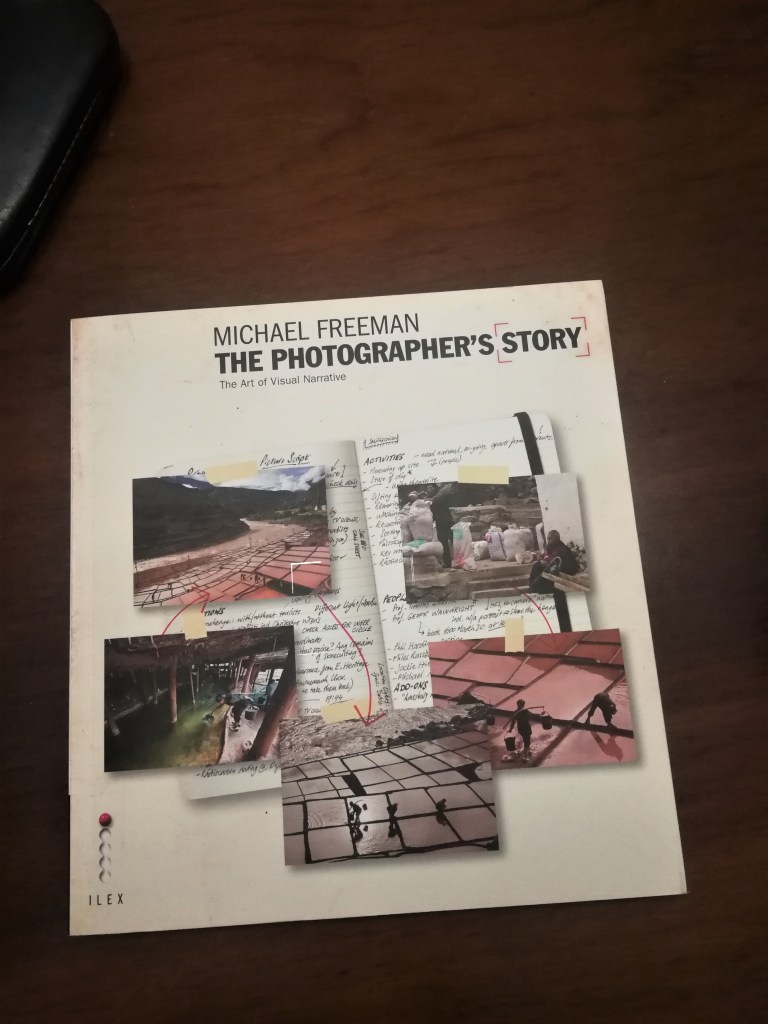
Reflecting on my reading of Michael Freeman’s The Photographer’s [Story] (Freeman, 2012)
Cover of the Photographer’s story (Andre Nagel, 2019)
Introduction
In my Work in Progress Portfolio submission for Position and Practice, I perceived a need to take a deeper look at how I need to present my work that it is less repetitive and more engaging. I identified this work by Michel Freeman as a good base to start from before engaging in deep research about the subject. I found a small Gold Mine…
Abstract/Overview
” The camera is only one tool for telling a story” for us, this is our prime interest. This means that as photographers we need to understand the fundamentals of story telling. regardless whether it is “written or spoken words, theatre film or still images, paintings or a cave wall.”
Freeman defines narrative as ” telling an account of something: how it happened.” He describes in some detail how photography was caught up in narrative since its inception and how the technology development made this more possible through time. Photographs replaced drawings in newspapers and came with a heightened perception of truth. He adds: “it took approximately a century in the form of digital manipulation, to take photography back to the very thing is was to replace!”
Technology such as smaller format cameras, the sprocket film and high-speed lenses with low light capabilities., faster film enabled photojournalism.
But it was not only the technology that drove this: “The camera and 35 mm camera came of age in Europe at the time of social and political upheaval” Photography also synced well with the “liberalism idealism in arts of the democratic and socialist movement in that time. It is not surprising that it led to politically inspired documentary photography seeking to challenge war and social injustice. It also aligned well with modernism that “rejected tradition and the decorative, instead of embracing abstraction and, clean lines, functionality and even mass production” it slowed for a new era, capturing scenes from life and art with spontaneity and conscious realism.
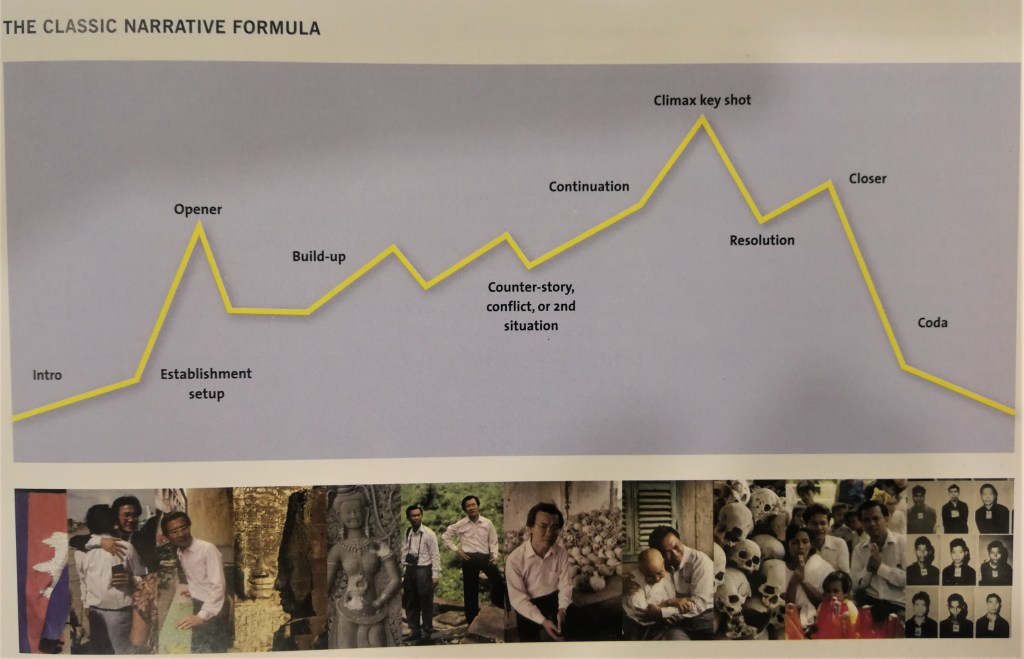
He then proceeds to introduce the classic story structure from literature and screenwriting to set the scene for his exploration of the narrative in Photo-journalistic and documentary photography. He uses three photo stories or essays to illustrate how uses the narrative in photography in his practice. (Freeman, 2012)
The classic Narrative formula (Freeman, 2012, p13)
Reflection
I believe Freeman has a very clear understanding of the world he saw photography development and his analysis is spot on. His books have been a tutor in my life since the 80’s when I purchased his 35mm Handbook where he while, teaching me the basics of using my camera, introduced me to the professional world.
In this book, he impressed me by how he described the natural alignment and convergence of journalism, photography and it associated technology advancements and the socio-political environment and how photography was able to serve the need of that era which continuous to date.
The narrative approach did three things for me. 1) It gave me a language to describe the purpose of photographs shot in a series. 2) It redirected me and removed the pressure of having to take key photographs all the time opening a world of opportunities. Not all of the photographs in a story need a Barthesian Punctum. A minor photograph may be used to establish the background, open the photographic essay with with a dramatic opening and buildup towards a key photograph that as an climax presentation of the punctum, and end of with a closing photograph leaving you to ponder the series as a whole 3) It allows me to assess how I can approach the way I present the photographs in an order that will reduce repetition and introduce rhythm and pace in terms of composition, angle and point of view, subject type, colour and impact and other visual factors. 4) It enables me to curate my photographs not merely on an intrinsic level but also its contextual importance in a series of photographs.
Of course, a photographic story can be told in one photograph, a small group, what Freeman calls a 3+1 combination, for magazines or a photo essay of 200-300 photographs in the form of a published book. But the ideal narrative form needs at least some a setup, a buildup, a climax and a close to be effective, whether as elements in a photograph or a series of photographs. I will be exploring this in my project work.
The contemporary practise of wedding photography is progressively adopting the story/ narrative approach in the renewed interest in high quality published albums. Some Master wedding photographers such as Roco Ancora, Joe Buisink and Yervant has adopted it within their style. The photo album or presentation is no longer a collection of photographs but a published essay on the most important day in the life of a young couple.
I did a stint in doing wedding videography which informed my photography practice in a major way. When my wife and I curated the thousands of photographs and needed to cull the photographs to about 300 for an album we intuitively broke up the day into chapters with each building up and leading into the next. Our climax was mainly the post-wedding Romantic shoot and we always looked for a “show stopper that will end of the Album. The wedding narrative is generally set but I never considered using the story approach in my personal documentary work until now.
Freeman, as a seasoned travel and documentary photographer has a large repertoire and years of practical skills and is prepared to share his skill in such a simple, pragmatic and delightful way.
Reading this book during week 3, where we discussed the tension between Art and Commercial work and how art is also commercial work, I was continuously seeing how for Freeman’s commercial work, event reportage and essays, is an art form. and it is the narrative within his work that elevates it in the traditional definition of art.
In conclusion,
I have come to realise the huge impact of how understanding narrative and its value within my photographic practice. Photojournalism and Documentary photography has always been underpinned with some form of narrative. For the photographer, the prime objective is the visual narrative, making it an integral tool in the arsenal of a photographer. And if this fails either personally add a literary narrative or collaborate with someone to add it. This has been the practice in many photographic essays I have read.
Reference
Freeman, M. (2012). The photographer’s story. Lewes: Ilex, pp.8-39.
Going back to the seventies, as a male, if I was thinking about a career at school, doing an art degree would the last thing to be considered, even if my dad and I both loved and practiced art. Baby boomers had to get a “real Job” to feed their families. The chosen career had to be at least sustainable until you retire. I followed my dad’s footsteps into an Electrical Engineering (electronics) and the rest is history.
Today there is a new world of opportunities and the way we look at employment. Employment is no longer based on a lifelong career and you are not expected to work at one organisation for life. The Current employee or business need to rediscover itself in the context of and ever changing world and reeducation and developing of new skills is required more often than in the past.
This weeks classwork left me with an impression that there is a “Real Job” in photography. Not only one but many. And I reiterate: it is photography related. This was a mind blowing realization for me… Starting with the interview in week 1 with Lydia Pang, Ted Forbes’s discussion on why one should study a degree, followed my the contemplation of the incomplete listing in the section, Presentation – Other Careers in the Photography Industry, reaching its apex in the Interview with Gem Thatcher and closing with the redefinition, for me, of what a professional photographer is in the presentation by Module leader Anna-Maria Pfab– DNA of a 21st Century Photographer based on Grant, Scott, Professional Photography: The New Global Landscape Explained
If you follow my blog you will see the start of this transformation. My Initial “Busines plan” was to become a freelance photographer, earn most of my income from wedding photography and expand my photography work through doing education in photography. The latter being the main motivation for me seeking a higher education and my MA. But this mind set is changing,
My first shift even happened before I started with this course when going through an introspection (Nagel,2019), I realized that I had a deep desire to find a way to express for myself as a human being. . ” I always felt the need express myself, to take photographs, paint, draw, write, teach, study …do more…. I know now that I have been missing my artistic expression (Nagel, 2019).” At that time I decided to embark on a path, not governed by my need for an income, even if that is important, but to make the the path that I want to walk for the rest of my life.
Let me share what inspired me this week. Gem Fletcher interview with Lydia Pang (Fletcher, 2019) as a youthful idealist showed me a proactive approach to get what you want. That you did not need to know your way but to “try everything” to discover what you don’t like and continue with and pursue more passionately that that you do. As far as commenting on opportunities, she also made it clear that in the post internet environment, all links are equal and that the internet and social media. If used properly , provides the opportunity to make yourself authentically available and present your work to the industry to parties that is looking for your viewpoint. And the biggest learning for me is something that is not new, is that we are primarily creatives seeking other creatives to participate in a common collective. Ted Forbe’s podcast reaffirmed that this is higher education’s greatest benefit.
The sample list of careers in photography, elucidate the way one can align your particular skills with a direction without compromising your primary passion, photography. Photography and video is arguably becoming the largest communication methods and it is still an emerging and growing field. This means that, even if the need to be a professional photographer is seemingly on the decline, due to citizen journalism and the proliferation and ubiquity of photography, there is an increase in demand to leverage from specialist in photography to use this photography. New interest is growing for creative professionals that need to interact with corporate as well as individuals that know how to leverage from these mediums. Corporate needs to make the most of these opportunities that this present. And that this landscape is ever changing and vibrant!
During Marianne Hanoun’s Gem Fletchers interview Fletcher states: “Being a good freelancer involves more than great creative work. You need to be able to pitch your ideas, market your brand, manage client relationships and budgets, and think strategically (Hanoun, 2017) .” Her multitude of roles reinforced the idea that you don’t have to paint yourself in a specific corner to make a success in this industry.
Unlike Pang, who does personal work as an escape, Fletcher illustrate that she also does personal projects to try new avenues and interest and staying hands on. Keeping her current. Pang focus more on writing about and looking at photographs and photographers rather than making any herself. Both approaches are fine today.
Fletcher is prepared to cross the “holy” divides. As she says: “The industry is constantly shifting and evolving and the opportunity to work across multiple disciplines is now embraced rather than frowned upon. This is really liberating (Hanoun, 2017) . “
Fletcher and Pangs interviews opens up the world of possibilities to me and I have decided to not be too rigid when planning the development of my practice and immerse myself to her concluding wisdom. “The number one would be make work. You learn more and faster from doing, than anything else. Get out in the world, make connections with people, collaborate with friends. Don’t be afraid to reach out to people for advice or feedback, but be smart about it (be short, clear and concise). Make the most of opportunities, ask questions. Be curious and open. (Hanoun, 2017)
The final part of my discovery lies within the tri-classification by Scott of professional photographers. When researching the market the local market and having no insight into corporate photography opportunities I came to the conclusion that most the most sustainable commercial opportunities lies as a “Domestic Professional”. Wedding, boudoir, pre-and postnatal and portraiture photography seemed the only way to guarantee a sustainable income. We don’t have access solid market information in South Africa and most of my peers work as either full time or part-time domestic professionals. But that was just a perception created when using the internet to do research. It is the prevalent marketing engine for this type of photographer. It was also the level I felt the most comfortable in. While there is a lot of competition in the low end market, the mid to upper market is still a great opportunity.
It was the general professional and high-end professional levels that has proven to be eye opening.
According to Schott ” the high-end professional who works with a cross section of professional clients within one or across a wide spectrum of photographic genres.” is the highest inspirational level for creative professionals in the photographic industry. “They are defined by a high quality client base, which in turn results in a strong financial reward for their work (Scott, 2014).”
To get there you need to become a general professional. “The general professional who also works with a cross section of professional clients within one or across a wide spectrum of photographic genres. They have a slightly less prestigious client base and therefore receive a lesser financial reward for their work.(Scott, 2014)”
Scott Makes the point that “they usually come from a creative academic background and are informed by the work of their peers” I.e know how to work in a collaborative environment. Both of these areas are focused on creating, keeping, and enlarging their commercial client base.
I am currently an IT architect and these statements in a way hold true. I work mainly for some of the largest IT organisations and collaborate with peers on major projects. Corporates actually find me through some of my peers as my reputation is build from previous engagements. I am currently freelancing. It is also a competitive environment. I really did not realize until now that if engaged with corporates, such as editorial, ad and branding companies, that require photographic skills, I would discover a whole new world of opportunities. It is something I need to test.
As I intend to do documentary photography, I need to identify enterprises and collaborators that I can engage with to achieve this goal.I will make this part of my project.
I would be able to use my current skills and the Masters Degree to migrate myself from IT to the creative professional I always wanted to be. Having an up to date degree and years of experience as a domestic professional, and doing personal projects during the next year and a bit will go a long way to get started. However, I will need to build that reputation through internship,work and collaboration on private projects and marketing myself to corporates and as Pang recommend use the platforms they will use to present my work . Even If Pang states that we can be found, because corporates are looking, I believe personal relationships in the industry will also go a long way to getting me commissions. The only hurdle is that I am 60 and may be perceived as being too old. But I am up for that challenge, and as long as my health and mental acuity persists I may land myself a dream project. I have already discovered that as a freelancer you are always as good as your last job.
To conclude: a career in photography is a real job! And I need to consider it! Even if it is just for living out my dream! But the path exists and I need to take control of that and decide which way to go.
Initiated by our Tutor we contemplated the rights of the subjects in the plagiarism photographs and whether the model release form from the original photographer/artist legally cover the second appropriation of the image?
There was also a sense of discomfort that the rights of the model/subjects are not being considered in both these cases. Especially when in both these cases their include people from the BAME* community.
I could not agree more. the terms of the release form should apply. Especially when it comes to documentary work where you have the opportunity to engage with people. I have done some street photography in the past where I did not ask permission to photograph the people. There is no law prohibiting me from doing it in South Africa. However, for my current project work I feel ethically challenged to ask verbal permission to photograph people and explain why I am doing it. I am guided by David Goldblatt’s approach which allows me to engage with my subjects. This becomes a very personal and life-changing exercise for me. But, in some cases, under certain circumstances, I need to take the photograph first. In those events, I will ask permission to use the photograph and I will delete the photograph if they disapprove. This process allows me to engage them in conversation and record their story and become less of a Flaneur. I am contemplating, where possible, returning to some of my subjects and give them a photograph and may consider getting them to sign a release in turn if I intend exhibiting it in the future.
The rights of the people being photograph blur a bit in the case of journalism were getting the subjects to sign off is near impossible as it gets to photographing riots and protests. That is probably why David Goldblatt generally avoided doing it or using those photographs in his exhibitions.
This should explain why I was so active in this forum discussion. I am personally experiencing the threat of my work to be abused in the same way.
One of the Disputed Artworks in the case Prince vs Cariou (Boucher et al., 2019)
During this week 2, we were challenged to discuss copyright issues. “There have been some notable art copyright cases in recent decades. One of the most significant is French photographer Patrick Cariou’s claim, suing Richard Prince and his gallery, Gagosian, for copyright infringement.
Ethics vs Law (Do we still care?)
I share my responses as I believe they reflect on my thinking. and growth during the process:
There are ethics and laws. Not all laws are ethical. I am a South African, and I experienced that personally.
I don’t need to be a lawyer to know that taking someone’s work that cost him years of effort and research to create and without his consent then muck it up for purposes of art, is blatantly unethical. It does not matter if the law says otherwise. Its common sense. But that is my emotional response.
Judgement under American Law
However, ethics weren’t challenged but the American Copyright Law. To provide and evaluate this case one needs to do some research into copyright law and the context. Landmark decisions are exactly that. A point in time in law where a boundary is challenged and crossed.
According to a study done by Suzy Frankel, Professor of Law, Victoria University of Wellington ” Copyright law internationally is awash with legal and practical problems and divergent political views (Frankel, 2015) .” Copyright is territorial, not international. And there is a need to find a durable solution.
Two sections in American copyright Law Apply.
“104. Subject matter of copyright: National origin” which states:
(b) Published Works.—The works specified by sections 102 and 103, when published, are subject to protection under this title if—
(1) on the date of first publication, one or more of the authors is a national or domiciliary of the United States, or is a national, domiciliary, or sovereign authority of a treaty party, or is a stateless person, wherever that person may be domiciled;
(2) the work is first published in the United States or in a foreign nation that, on the date of first publication, is a treaty party; or ”
This part was not contested.
“107. Limitations on exclusive rights: Fair use which states
Notwithstanding the provisions of sections 106 and 106A, the fair use of a copyrighted work, including such use by reproduction in copies or phonorecords or by any other means specified by that section, for purposes such as criticism, comment, news reporting, teaching (including multiple copies for classroom use), scholarship, or research, is not an infringement of copyright. In determining whether the use made of a work in any particular case is a fair use the factors to be considered shall include—
(1) the purpose and character of the use, including whether such use is of a commercial nature or is for nonprofit educational purposes;
(2) the nature of the copyrighted work;
(3) the amount and substantiality of the portion used in relation to the copyrighted work as a whole; and
(4) the effect of the use upon the potential market for or value of the copyrighted work.
(US Copyright Office, 2019) .”
Which means both are protected under American Law. And maybe challenged under section 107 (3)
So if Patrick Cariou wished to have protection in America, he need not have to register copyright in America and may use the laws there when a breach arises. It needs to be done under that Jurisdiction as the breach occurred on American Soil. American Copyright Law only applies to America and its laws apply there.
The additional purpose of the Fair Use criteria provides a counterbalance to the 1st Amendment of the American Constitution, that of Free Speech. The Office of General Counsel at Harvard University notes that the five “Fair Use” tests are “purposely broad to prevent a rigid application that would potentially stifle creativity” (Harvard, 2019).
“Courts have taken both a quantitative and a qualitative approach in assessing the impact on the fair use analysis of the amount and substantially of the portion used. What percentage of the original work has been used? There are no bright lines, but the higher the percentage, the more likely this factor is to weigh against fair use.
Even if the percentage is fairly small, however, if the material used is qualitatively very important, this factor may weigh against fair use (Harvard, 2019). ”
It’s important to note that American Law is about the precedence and it is little wonder that it is the Andy Warhol foundation that fought for the American artist as Andy has done this without challenge in the past. They tout precedence in the form of Art history.
‘The district court determined that Prince’s “taking was substantially greater than necessary.” We are not clear as to how the district court could arrive at such a conclusion. In any event, the law does not require that the secondary artist may take no more than is necessary. We consider not only the quantity of the materials taken but
also “their quality and importance” to the original work. […] The secondary use “must be to `conjure up’ at least enough of the original” to fulfil its transformative purpose. ] Prince used key portions of certain of Cariou’s photographs. In doing that,
however, we determine that in twenty-five of his artworks, Prince transformed those photographs into something new and different and, as a result, this factor weighs heavily in Prince’s favour (Patrick CARIOU v. Richard PRINCE, 2013) .’
Initially, I did not agree with the ruling only taking the quantitative side in consideration. While it is clear the copyright was infringed on quantitative bases the ruling was made on a qualitative basis. In this, I need to concur. Prince completely changed the intent of the photographs. But as discussed under in my blog on The Rights of subjects in documentary work (Nagel, 2019). This is something that was not challenged in this case. it is the effect of these minor changes that infuriated me and possibly Cariou. The reason he won the case… Is this really fair use really fair in this case?
But I learned a lot critically analyzing this case. but this only applies to American law.
How would other Countries deal with this?
But this poses another question. How would this case have been adjudicated in other countries? I concluded a brief investigation on how copyright laws of other countries would have dealt with the issue.
In France, the French court needs to determine if a work is an original on a case by case basis. France calls on moral law in these cases. Copyright needs not to be registered. Copyright exists merely if something is created. these rights are split between patrimonial or moral right. Patrimonial rights cover the artwork for 70 Years after was published. Moral rights have no time limit.
The moral law states that the original author has the legal right to protect the integrity of the work…and the right to oppose any modification or distortion of the work. So Prince would have lost, even after the authors’ death. Prince 1- Cariou 1.
Acts for the purposes of royal commissions, statutory enquiries, judicial proceedings and parliamentary purposes.
Recording of broadcasts for the purposes of listening to or viewing at a more convenient time, this is known as time-shifting.
Producing a back up copy for the personal use of a computer program.
In Britain making a Caricature, parody or Pastiche of a BAME subject would not have been approved. Prince 1- Cariou 2.
In South Africa, we don’t have a fair use policy as mentioned in Amy’s and other posts. You require permission to adapt an original piece of art which includes photographs (Myburgh, 2019). A gallery can’t even use an image of art to sell the item without the distinct permission of the copyright owner. Prince 1-Cariou -3
I question whether the problem is that, unlike South Africa, that documentary photographs, in general, is still not seen as art in itself. That it is relegated to a lower purpose. To be used and abused? The precedence so important in American law is made! Would they allow fine art classics to be vandalised in the same way? Probably.
So in conclusion: It is what is deemed sufficiently transformational that is tested in this case. So due to the precedence, I can make a couple of scratches on the eyes of the subject and add another authors photograph of anything and it is deemed as sufficiently transformational.
What bothers me is that Patrick had no moral recourse under American law. Something he would have had in his own country. Under American law, the author loses all moral rights to the use of the picture. It is no wonder documentary photographers find it more difficult to find willing subjects in America. The moral obligation that Caroui had was to protect the dignity of a private subject has been waved in lieu of a joke, parody or caricature etc. This subject of his photograph is not a politician or celebrity that puts him/herself up to public ridicule. For me, it equates to the display as Sarah Baartmans body as a museum display in Paris (Smith, 2019). This is disrespectful. It is a human right abuse. Imagine if you were commissioned to do work for a bride and an American artist decide to do the present her in a degrading fashion. How will you be able to explain this to your customer? Does it make any difference that this is an indigenous person that doesn’t live in America and probably cannot afford to sue the hell out of the artist? Rastafari is religious individuals and takes their simplicity and way of life very seriously. Not merely stoners and rock artists as the artist portrait. (Added 01/10/2019) I know I would offend if I really have to say how I feel. I may have already…I lived in a country for many years where human rights were abused and I remained silent. People tend to hide behind unjust LAW’s to abuse the rights of others. It was never the intent of the law. In South Africa, this was corrected where Human Rights were embedded into our constitution and human rights charters, which takes precedence over any interpretation of the LAW that transgresses that. We have a specialised court that deals with those matters. You are free to publish in South Africa and don’t need to register copyright and own your copyright unless you wave it, and I believe you will get a fair trial. I know this will be tested here in the future. It makes me rethink how I make available my work and who I collaborate with to ensure that American Vandals/Artists cannot get hold of my work. David Goldblatt, a world-renowned documentary photographer, removed his work archive from the University in Cape town in protest to students vandalising imperialist art and being able to protect the freedom of expression and moved his archive for protection at Yale. How safe is his work really? Incidentally, he claimed that he was an artisan and disliked Artist. I wonder why? (Herman, 2017)
Our tutor Clare Bottomley challenged us to look at another interesting case involving an iconic photograph. She asked whether the feeling around fair usage change when the image is so well known it becomes part of our collective consciousness?
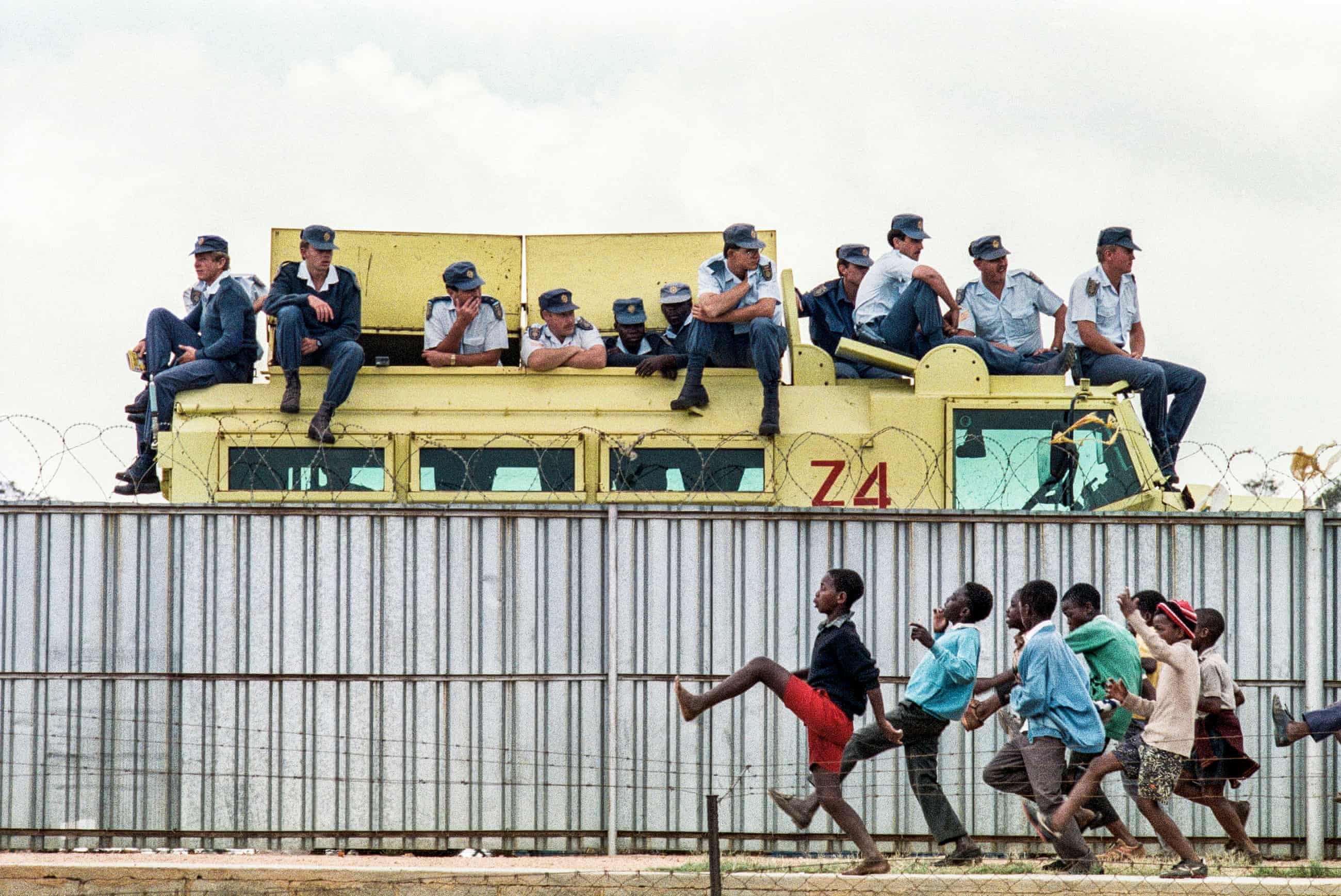
The photograph by Graeme Williams taken in Thokoza township, Johannesburg, in 1991. Police watch an ANC rally while children taunt them. Photograph: Graeme William (McGreal, 2019)
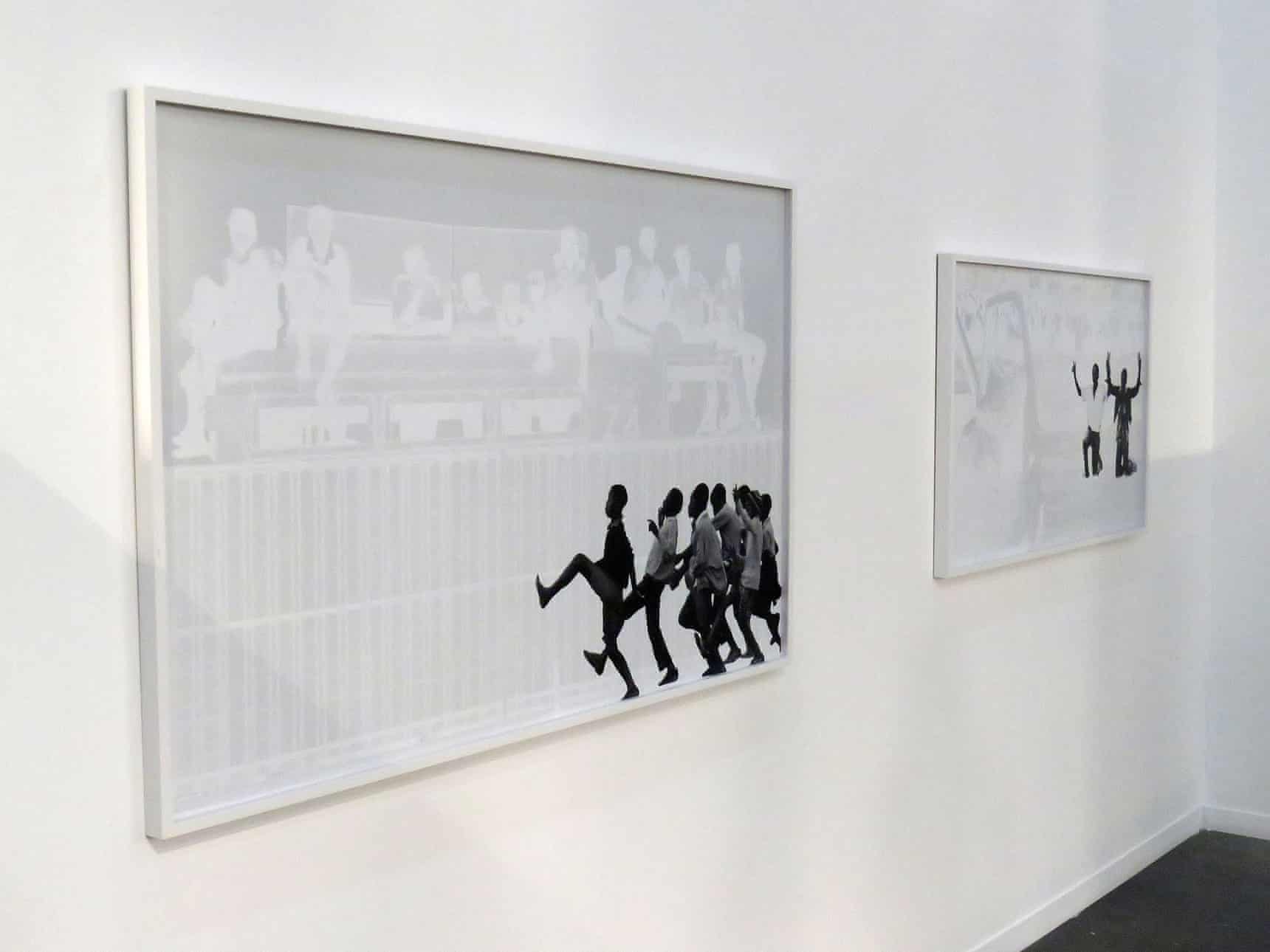
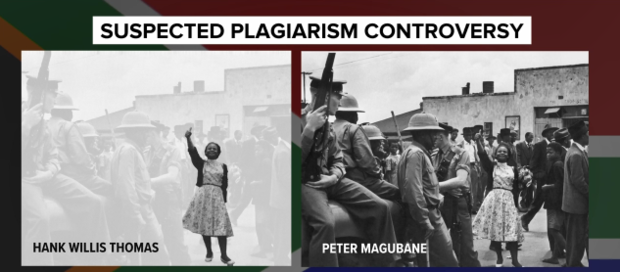
The photo was taken at the Johannesburg art fair by Graeme Williams of Hank Willis Thomas’s version of Williams’s colour original. Photograph: Graeme Williams (McGreal, 2019)
I thought this is a better case to argue… Wiliams is making an artistic point. He may win based on transformation in an American court but at least he did a better job than Prince. If he labelled or documented his protest up-front I would have some sympathy for his purpose, but he didn’t. He was caught claiming another photographers work as his own and looks like merely trying to get out of trouble. Alternatively, he could have argued that he significantly altered the photograph but require him to present it to the courts. He basically admitted that he stole it and he feels it’s ok because he did not believe it was previously stolen and did not belong to the owner. I wonder if American law will uphold that. He even asks the artist to destroy the evidence.
Copyright Law court expenses are huge. My cynical response would be to simply copy what he did using photoshop, it may only take a day at most and give it to the gallery to sell at the same price and display it next to the other and use this conspiracy to my advantage… He did not change the meaning of the photograph and merely suggested how to change it. Challenge the gallery to sell the original with proof of ownership to a prospective client. If he wants to challenge the “copyright infringement he will then have to fight the lawsuit in South Africa using South African law. He will not win the case. It would be interesting to me whether art buyers will buy the stolen one, or the original, merely because of the artist’s name. (And if not, provide my originals to him to sell my photographs for me under his own name – he can cut out the middle man, he is clearly a better salesman)
However, I pursued the matter further. Williams was not the only photographer against whom this infringement was done. Here is another.
Photographs by Hank Willis Thomas and Peter Mgubane (Patta, 2019)
He did the same with Peter Magubane’s. Thomas said he’s not so interested in the legal debate, and more interested in the moral debate. CBS News foreign correspondent Debora Patta said he raises the argument that Williams is a white photographer who took pictures of black South African kids without their permission. He wanted to make it a racist debate. This is the artist version of Click bate. Why then rob Peter Mugubane? According to Patta both South Africans that risked the lives to get the story.
The article states: “South African copyright laws are clear: You may not reproduce or alter an original photograph without the owner’s permission. While U.S. laws may not be as stringent, copyright lawyers told CBS News the original works are clearly identifiable in the works by Thomas, which amounts to copyright infringement (Patta, 2019) .”
Ted Forbes has been a great inspiration to me in the past. I came across his site when studying the history of photography. I was delighted to see him being used as part of recommended listening. I have not listened to this podcast before and found it a confirmation of my motivation to studying for a degree. He starts out stating that a degree is not essential to become a successful commercial photographer. But if you do you will find benefit but you need to asses whether you are suited to such a study, whether you are prepared to commit to the time required, and whether you are prepared to financially invest into it.
Forbes asks what would a photography degree provide for you and proceeds to answer the question.
“A photography degree would actually provide a very special environment. If you choose the right school with the right instructors you’re going to have a very focused environment where you’re going to be with other people who are doing exactly what you’re doing. That you’re going to get to know. You’re going to get to bounce ideas off, going to provide an environment for you that is full of critiques and peer reviews, assignments that you’re going to do large projects and it’s going to be very focused kind of thing for a while and if you are willing to put the work into that you could get quite a bit out of it and I think that is pretty exciting and if you’re at a point in life where you really feel like that is something special that would work well for you. Highly recommend going for it now (Forbes, 2015). ”
The second motivation that “If you wanted to teach photography in a university one day they certainly are going to ask for your degree (Forbes, 2015) .”
Ted ads to the benefit . “it says that you finish something in life people look at that and it says that you were able to finish things.The ability to finish projects, the ability to work with other people, the ability to follow instructions by an instructor even the ability to learn a little bit about politics and just how everything works and these are really hard to explain (Forbes, 2015).”
My main motivation for doing the degree and therefore the masters is two fold. My highest qualification is a Higher technical diploma in Electrical engineering. At the age of 60 I wanted a way to keep my mind sharp and develop my intellect. I felt the need to study something in the humanities and art For the level of thinking I wanted I could not identify something that will keep me interested and challenge me. There was nothing I could do part-time and I thought what I would like to do after my retirement from information technology. And her it is: I discovered that I wanted to teach Photography. I wanted to share my passion in photography with a younger generation. And I knew that even if I thought at a rudimentary level I needed a way to prove my capability. merely showing your work does not cut it if you have seconds to prove it on the internet. And a Degree in Photography would do it for me. I also aspire to teach photography either on a part-time or full time basis at a higher education. Ted confirms that this is exactly what I need to do if I want to get into there. (I have tried to get in without it and have had no success in that.)
The second benefit is one of the great surprises. In the 40 years of my photography I never felt the need to collaborate. I worked on my own and have very few peers to share my passion. I hate photography clubs that I visit as I disagreed with the their approach. it was more about boasting than teaching. I discovered my peers in the degree. I believe that this is the part that this weeks education is about. Why we are encouraged to participate in common assignments. Share our thoughts in forums. build relationships….
I need to reflect on one other aspect. I love research work. The contextual and focused reading is a benefit that is not mentioned. For me I am now dealing with issues that I did not think about or dealt with in detail in the 30 Years. This work is going to greatly influence my direction and abilities in my practice. Add to that the ability to look outside my rigid box after 40 years in the industry, finding encouragement from others and to be able to dream. If I find another younger version of myself, I will encourage him to make the investment and get a degree in a subject that really interest you. While a commercial value needs to be attained, it should not be the primary driver for one that seeks a higher education. It should be an enabler to open the door into a wider experience and knowledge which should be translated in a real world ability afterwards. Such an education is priceless … The cost is high but the benefits looks to outshine this. Jarid Polin in a nother podcast recommends it for the colaboration, and the building of a network of peers and advice that this is better achieved through a longer study period.
Both Ted agree that 1) Its not essential for success, 2) that you need to know what you want to achieve, and 3) that they recommend it if you can motivate the financial and giving yourself to the required studies, assignments and collaborative engagements that such programme offers.
Ted add that one should select an education path that include a institution that offer capable staff, and ample opportunities for this. Jared Polen also encourage practical shooting and engaging with you educators to get the maximum benefit from this opportunity. “So, take the photography classes, but also get involved with anything photo-related, call the president of the school and so you want to do a photo shoot with them, do a project photographing all the professors, doing video of the professors, getting their opinions and capturing that for a project. Just do it, you pay to go to these schools so use that to your advantage, you ask for things because you’re paying the school to allow you to do that stuff, so take advantage of all of that that you have in front of you (Polin, 2019).” Unfortunately as a distance learner I will miss out on that opportunity, however, his comments does encourage me to make the most of every chance to engage. I see the Falmouth flexible as the best remote study programme for this and I commend them for setting up an remote study environment that encourage collaboration, common discussions, peer review opportunities through conferencing and engagement and group challenges to encourage this.
There is a another point I wish to make, which speaks to higher education. When I was younger, our educational opportunities was split between College, Technikons and University. Training was done in a continuum ranging from the practical hands-on rules based education (college- certificate), engineering/technical level education for industry (Technikons – Diploma level) and research, academic and scholarly education in Universities ( Graduate degrees, and post graduate education). The commercial orientation to higher education seems to be focusing modern universities on commercial employment making them more aligned with the Technikons. It may be because of the lack of research opportunities and value in art and humanity education. Photographers, artists and other visual practitioners can and should be educated at all three levels.
If the changing trends indicate that a Degree in Photography intend to prepare professional photographers for business ventures then I need to agree with Polin that he “would go into business, branding, and marketing with a minor in photography, with a minor in advertising, with – what else do I have here business marketing, audio/video, anything that has to do with being creative that will allow you to step out into the world and be able to take on multiple roles. I would go into business, branding, and marketing with a minor in photography, with a minor in advertising, with – what else do I have here business marketing, audio/video, anything that has to do with being creative that will allow you to step out into the world and be able to take on multiple roles (Polin, 2019) .” Or it is merely a confusion created by selling of higher education programme’s. I joined the course to go beyond the aim of merely pursuing a legal tender. I can currently generate higher earnings in IT and business. I believe getting a return of ones investment is less financial than it is to value that you can unleash through growth in your intellect, creativity and out of the box thinking. The techniques for this is best obtained through studying for a graduate and post graduate degrees. A value the world won’t be able to acknowledge until you serve that purpose. And yes, you may achieve it on your own, but this is very rare.
Polin, J. (2019). Should You Go To College To Become A Photographer? The Truth About Photography. [image] Available at: https://www.youtube.com/watch?v=Nc5kzpiUK6I [Accessed 13 Oct. 2019].
Reflecting on the Essay By Shirley Read contained in a chapter within Photographers and Research.
Brief abstract:
Read starts her essay with two questions: “How important is it for artists or photographers to find a subject matter that is particular to them?” and “What do we (curators) mean when we talk about the central concerns of a photographer’s work?” She then attempts to answer the question; ” I am is looking for what is at the core of any work. What I am looking for will carry with it the sense that the work is powered by the authentic concerns of the photographer, that it is in some way heartfelt and has the integrity to its approach to the subject.”
She then proceeds to motivate her answer by sharing her research. These include a practical test to determine in what way unsolicited observers can identify an artist by viewing their photographs and the responses of many successful artists. She determined that “a photographer will have long term preoccupations. These preoccupations may either be in either abstract or material ideas or subject matter, an approach to the world or to the making of the works.”
Read finally concludes that this may initially be developed through taking Input or feedback from others and may also necessitate feeling one’s way through the process of making work. Not knowing will become a knowing. She reaffirms that she believes “that the recognition of their particular subject matter is crucial to the long-term progression of the work of any artist or photographer. And that this recognition may take time and accumulation of work. …evidence of where they have been and point to the future” (Simmons and Read, 2016 pp 218-222).”
Reflection
My initial response was sceptical, that as a curator Read wants to categorize and package the creative work of individuals. But reflecting on my body of work I need to admit that there is a line observable and in some cases is not my primary concern in life, but the most dominant. … How I see the world and its people. Mostly imposing my view of myself and the world on them or alternatively how they perceive the world and themselves…
After my initial reading of the essay, I took a break and watched a documentary on Netflix, “Abstract: The Art of Design“ featuring Olafur Eliasson.
At one-point Eliasson describes his creative process which fascinated me. But it is best described in his own words which he repeated in an interview with Rachael Cook for the Guardian. I added photography for contextual alignment.
“You have an idea… an intuition, a feeling, a subconscious thing. It comes in many versions, but when it does it is sometimes better to go back and ask where it came from than to immediately decide where it is about to go. If you know where it came from, you might know why you had it, and once you know why, it’s easier to know-how. The brush or the pencil:” (or Taking a photograph),” they’re just tools. The playing, the fooling around; you need to step out of the macho-driven goal-orientated brutality of today’s success criteria. You need to be confident of the step you are taking, not of where it will take you because the moment you put the pencil to paper” (or make a drawing with light) ” is the moment when you change the world.” (Cooke, 2019)
These ideas can be visual and still require words to form. (intuitive). He realizes that there needs to be a reason for their occurrence and states that as an artist it is his job to find the “why” of the idea and what initiated the idea from information that informed its creation. Once he establishes these answers, he will be able to formulate it into words and hands the words over to the practitioners to develop the “how” and build and model (artefact) that brings the creative idea to life. As Photographers we are both the artist and practitioners. The “why” needs to be answered before the “how”! I believe it is the “why” that is what Read identifies in the work of artists. This seems logical now. The only difference in his approach is that you don’t have to initially verbalise the why but visualise the why. Use your intuition. He added that gets the most creative ideas when he is busy working. (My interpretation from Abstract: The art of Design – Olafur Eliasson, 2019)
While Eliasson’s work seems to have no boundaries and seem creatively free he states: “I don’t think my scope is wide enough. My projects are all connected. There’s a high degree of synchronicity. And I have a lot of confidence in things like abstraction, so it’s not a big step for me to move from one medium to another.”
Read and Eliasson’s comments led me to briefly research how ideas are formed in the brain. The ScienceDaily has an article about a study done at Haifa university on how our brains develop an original and creative idea. In summary, the researchers discovered that “Developing an original and creative idea requires the simultaneous activation of two completely different networks in the brain: the associative — “spontaneous” — network alongside the more normative — “conservative” — network; (ScienceDaily, 2019)
So in a way, our new idea only substantiates when the spontaneous part and conservative part concur. This process is mostly subconscious. Eliasson stated that his creative ideas increase with hard work (Abstract: The art of Design – Olafur Eliasson, 2019), which I take to mean that the “conservative” generated by actual work deliverable or outcomes allows for more “spontaneous” agreements …therefore more creative ideas.
In conclusion: The creative process requires that we look back on a body of work or and we will see how your creative ideas are informed from our previous work. This does not necessarily be a lifetimes body of work. Even an immersive personal project, with creative ideas, can and will develop this. I currently find my current project and the related research both an introspective and retrospective of myself. I did not realize that this is my creative process. All this reflection and reading removed my initial scepticism leading me to the same conclusion that Read came to.
Wow! And I initially thought this essay had little value for me.
Reference:
Simmons, M. and Read, S. (2016). Photographers and Research. Focal Press.


 André Nagel's Critical Research Journal